


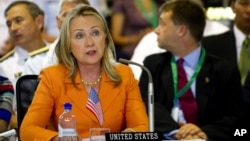
RAROTONGA, Cook Islands — U.S. Secretary of State Hillary Clinton is in the Cook Islands as part of the Obama administration's so-called "Asia Pivot" to boost the U.S. economic and security presence in the region.
Secretary Clinton says the United States is making a major push to increase its engagement across the Asia-Pacific region.
"This is a vast and dynamic region - a key driver of global economics and politics - and the United States has a historical presence in this region," she said. "That's why I have said that the 21st century will be “America’s Pacific century” - with an emphasis on “Pacific.” The “Pacific” half of “Asia-Pacific” doesn’t always get as much attention as it should, but the United States knows that this region is strategically and economically vital, and becoming more so."
She told Pacific leaders meeting in the Cook Islands that since the sacrifices made by Americans during World War II, the United States has underwritten the security that has made it possible for the people of this region to trade and travel freely.
"We have consistently protected the Pacific sea lanes through which a great deal of the world’s commerce passes," said the secretary of state. "And now we look to the Pacific nations in a spirit of partnership for your leadership on some of the most urgent and complex issues of our time, such as climate change."
The United States currently spends about $330 million a year supporting nations of the Pacific Islands. Additionally, the U.S. Export-Import Bank last year provided $3 billion for investment in Papua New Guinea following earlier assistance to finance U.S. trade with Tonga, Tuvalu, Fiji, and Micronesia.
Secretary Clinton Friday announced plans for new programs totaling more than $32 million to address a range of issues including conservation, sustainable development, and gender equality.
"Here in the Pacific, and indeed across the world, the United States seeks a model of partnership rooted in our common values but which delivers practical benefits and helps you create stronger economies and societies," she said.
Washington's ongoing "Asia Pivot" has been seen warily by some in the region, most prominently China, which has accused the Obama administration of meddling in regional affairs including competing territorial claims in the South China Sea.
Secretary Clinton says the United States welcomes the chance to work with partners in the region - including Japan, the European Union, and China - as all have a shared interest in advancing security, prosperity, and opportunity, telling regional leaders: "The Pacific is big enough for all of us."
Following the Cook Islands, Secretary Clinton visits Indonesia, China, Brunei, East Timor, and Russia.
Secretary Clinton says the United States is making a major push to increase its engagement across the Asia-Pacific region.
"This is a vast and dynamic region - a key driver of global economics and politics - and the United States has a historical presence in this region," she said. "That's why I have said that the 21st century will be “America’s Pacific century” - with an emphasis on “Pacific.” The “Pacific” half of “Asia-Pacific” doesn’t always get as much attention as it should, but the United States knows that this region is strategically and economically vital, and becoming more so."
She told Pacific leaders meeting in the Cook Islands that since the sacrifices made by Americans during World War II, the United States has underwritten the security that has made it possible for the people of this region to trade and travel freely.
"We have consistently protected the Pacific sea lanes through which a great deal of the world’s commerce passes," said the secretary of state. "And now we look to the Pacific nations in a spirit of partnership for your leadership on some of the most urgent and complex issues of our time, such as climate change."
The United States currently spends about $330 million a year supporting nations of the Pacific Islands. Additionally, the U.S. Export-Import Bank last year provided $3 billion for investment in Papua New Guinea following earlier assistance to finance U.S. trade with Tonga, Tuvalu, Fiji, and Micronesia.
Secretary Clinton Friday announced plans for new programs totaling more than $32 million to address a range of issues including conservation, sustainable development, and gender equality.
"Here in the Pacific, and indeed across the world, the United States seeks a model of partnership rooted in our common values but which delivers practical benefits and helps you create stronger economies and societies," she said.
Washington's ongoing "Asia Pivot" has been seen warily by some in the region, most prominently China, which has accused the Obama administration of meddling in regional affairs including competing territorial claims in the South China Sea.
Secretary Clinton says the United States welcomes the chance to work with partners in the region - including Japan, the European Union, and China - as all have a shared interest in advancing security, prosperity, and opportunity, telling regional leaders: "The Pacific is big enough for all of us."
Following the Cook Islands, Secretary Clinton visits Indonesia, China, Brunei, East Timor, and Russia.