


CAIRO — U.S. Secretary of State Hillary Clinton says Egypt's military should follow through on commitments to ensure a successful transition to freely-elected civilian rule.
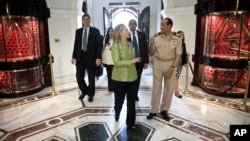
Secretary Clinton and Field Marshal Mohamed Hussein Tantawi met for more than hour at Egypt's Defense Ministry where they discussed the political transition and the military's ongoing dialogue with newly-elected civilian President Mohamed Morsi.
Soldiers still wield considerable power in post-revolutionary Egypt, especially following court orders dissolving parliament. The Supreme Council of the Armed Forces scaled back presidential powers shortly before Morsi's election. He is the first Egyptian leader since 1952 to come from outside the military.
Secretary Clinton is urging the Tantawi-led military council to keep its promise to fully transfer power to civilians and return to a "purely national security role." She commended soldiers for representing the Egyptian people in the revolution against Hosni Mubarak and overseeing free and fair elections.
"But elections are just the beginning," she said. "It's not the end of anything. Now a government must be formed, a government that will respect the rights of all Egyptians: men and women, Muslims and Christians, wherever they live in the country."
Clinton said Egyptians "have sacrificed so much to get to this moment," and the United States believes a strong, durable democracy that respects the rule of law and protects the rights of women and minorities is the best way to realize their aspirations.
"We respect the right of Egyptians to build their country, but we believe strongly that universal rights must be protected," said Clinton. "All people deserve dignity. All people deserve their freedom."
In talks with both Field Marshal Tantawi and President Morsi, Secretary Clinton discussed the Obama administration's offer of $1 billion in debt relief and $250 million in loan guarantees for small- and medium-sized enterprises.
Field Marshal Tantawi told her that is what Egyptians need most now: help getting their economy back on track.
Secretary Clinton and Field Marshal Mohamed Hussein Tantawi met for more than hour at Egypt's Defense Ministry where they discussed the political transition and the military's ongoing dialogue with newly-elected civilian President Mohamed Morsi.
Soldiers still wield considerable power in post-revolutionary Egypt, especially following court orders dissolving parliament. The Supreme Council of the Armed Forces scaled back presidential powers shortly before Morsi's election. He is the first Egyptian leader since 1952 to come from outside the military.
Secretary Clinton is urging the Tantawi-led military council to keep its promise to fully transfer power to civilians and return to a "purely national security role." She commended soldiers for representing the Egyptian people in the revolution against Hosni Mubarak and overseeing free and fair elections.
"But elections are just the beginning," she said. "It's not the end of anything. Now a government must be formed, a government that will respect the rights of all Egyptians: men and women, Muslims and Christians, wherever they live in the country."
Clinton said Egyptians "have sacrificed so much to get to this moment," and the United States believes a strong, durable democracy that respects the rule of law and protects the rights of women and minorities is the best way to realize their aspirations.
"We respect the right of Egyptians to build their country, but we believe strongly that universal rights must be protected," said Clinton. "All people deserve dignity. All people deserve their freedom."
In talks with both Field Marshal Tantawi and President Morsi, Secretary Clinton discussed the Obama administration's offer of $1 billion in debt relief and $250 million in loan guarantees for small- and medium-sized enterprises.
Field Marshal Tantawi told her that is what Egyptians need most now: help getting their economy back on track.