


Most scientists agree that the Earth is undergoing significant climate change, partly due to the greenhouse gases produced when fossil fuels like oil, gas and coal are burned.
However, earth scientists know that the planetary environment has always been in flux. Some of those changes have caused extinctions on a massive scale. However, for humans, higher apes and other large mammals, environmental fluctuations have sometimes been a goad to adaptation.
Geologists and climatologists, who specialize in the physical earth sciences, came together with biologists, paleontologists and anthropologists, who mainly concern themselves with life on Earth, for a symposium at Columbia University's Lamont-Doherty Earth Observatory, to discuss the question, “Did Climate Change Shape Human Evolution?”
“This is a meeting I’ve been trying to have for, I’d say, at least the last 10 years,” says Peter deMenocal, of Columbia University’s Department of Earth and Environmental Sciences, who organized the multi-disciplinary event. “The message from earth’s history is that climate has played a role in every major faunal change event in recorded history. That said, this question of how climate shaped or may have been involved in human evolution is very much an open one we don’t have an answer to. But we’ve got some very intriguing initial clues that point to a strong relationship.”
For example, around two million years ago, the climate in east Africa began to dry, which helped to transform huge wooded areas into the vast open grasslands we call “savannahs” today. Fossil records reveal that large mammals, including our own human ancestors, living in that area also underwent significant physical changes during that time and over the subsequent millennia. Ancestors of antelopes and zebras developed longer teeth with thicker enamel. This enabled these mammals to eat and digest the abrasive grasses that had become a staple of their new diet, deMenocal says.
"The human story is our brains become a lot bigger, our body assumes its very large upright form, our behavior changes," deMenocal says. "For instance, the first appearance of stone tools of any kind comes in at the same time as this drying [of the environment].”
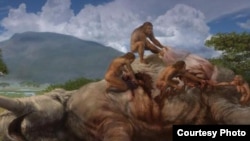
Although the overall environmental trend in Africa between two million and 100,000 years ago was toward dryness, the climate also fluctuated often between wet and dry. Because humans had developed a brain that could consciously adapt and innovate, they had an enormous survival advantage. When grasses dominated the landscape, they could make a tool to whittle sticks to get to underground tubers. When trees abounded, they could fashion rocks that would crush nuts. When game was plentiful, they could hone a stone that would scrape protein-rich meat off the bones of their prey.
Anthropologist Rick Potts, who directs the Smithsonian’s Human Origins Program, points out that this flexibility was not unique to Homo sapiens. It’s been a feature of all human species, including the now-extinct homo erectus and Homo neanderthalis.
“By the time we get to our own species, the ultimate representation of this picture of plasticity or adaptability is that we have diverse cultures," he says. "Within one species we have almost all the different ways in which people can marry or mate, the ways in which they can organize societies, the kinds of technologies that can be used. We are the first species to think about ‘What if?’ And that is a good response to a world that is very uncertain or conditional.”
Potts adds that humans’ increasing technological skill at bending nature to our purposes is triggeringing climate changes that might otherwise never have happened.
“So for example when we manufacture things, we put particulate matter into the atmosphere. We put up gases and things that become smog and that has an effect on the environment that is unintended.”
Those effects, such as global warming, the rise in sea levels and extreme weather events, pose new challenges to our species’ survival. Potts says that traditionally, we have taken two broad-brush approaches to this reality. We have either pulled back on our growth and ambition, which is hard, or we press on regardless of the long-term impact.
“And so we are really caught between these two visions, and I think the balance between those two visions will determine the history of us on earth.”
Still, Potts and many of his fellow scientists at the symposium on climate change and human evolution express hope that our awareness of the possibilities of our own extinction will inspire us to imagine and create new ways of living more harmoniously on an ever-changing Earth.
However, earth scientists know that the planetary environment has always been in flux. Some of those changes have caused extinctions on a massive scale. However, for humans, higher apes and other large mammals, environmental fluctuations have sometimes been a goad to adaptation.
Geologists and climatologists, who specialize in the physical earth sciences, came together with biologists, paleontologists and anthropologists, who mainly concern themselves with life on Earth, for a symposium at Columbia University's Lamont-Doherty Earth Observatory, to discuss the question, “Did Climate Change Shape Human Evolution?”
“This is a meeting I’ve been trying to have for, I’d say, at least the last 10 years,” says Peter deMenocal, of Columbia University’s Department of Earth and Environmental Sciences, who organized the multi-disciplinary event. “The message from earth’s history is that climate has played a role in every major faunal change event in recorded history. That said, this question of how climate shaped or may have been involved in human evolution is very much an open one we don’t have an answer to. But we’ve got some very intriguing initial clues that point to a strong relationship.”
For example, around two million years ago, the climate in east Africa began to dry, which helped to transform huge wooded areas into the vast open grasslands we call “savannahs” today. Fossil records reveal that large mammals, including our own human ancestors, living in that area also underwent significant physical changes during that time and over the subsequent millennia. Ancestors of antelopes and zebras developed longer teeth with thicker enamel. This enabled these mammals to eat and digest the abrasive grasses that had become a staple of their new diet, deMenocal says.
"The human story is our brains become a lot bigger, our body assumes its very large upright form, our behavior changes," deMenocal says. "For instance, the first appearance of stone tools of any kind comes in at the same time as this drying [of the environment].”
Although the overall environmental trend in Africa between two million and 100,000 years ago was toward dryness, the climate also fluctuated often between wet and dry. Because humans had developed a brain that could consciously adapt and innovate, they had an enormous survival advantage. When grasses dominated the landscape, they could make a tool to whittle sticks to get to underground tubers. When trees abounded, they could fashion rocks that would crush nuts. When game was plentiful, they could hone a stone that would scrape protein-rich meat off the bones of their prey.
Anthropologist Rick Potts, who directs the Smithsonian’s Human Origins Program, points out that this flexibility was not unique to Homo sapiens. It’s been a feature of all human species, including the now-extinct homo erectus and Homo neanderthalis.
“By the time we get to our own species, the ultimate representation of this picture of plasticity or adaptability is that we have diverse cultures," he says. "Within one species we have almost all the different ways in which people can marry or mate, the ways in which they can organize societies, the kinds of technologies that can be used. We are the first species to think about ‘What if?’ And that is a good response to a world that is very uncertain or conditional.”
Potts adds that humans’ increasing technological skill at bending nature to our purposes is triggeringing climate changes that might otherwise never have happened.
“So for example when we manufacture things, we put particulate matter into the atmosphere. We put up gases and things that become smog and that has an effect on the environment that is unintended.”
Those effects, such as global warming, the rise in sea levels and extreme weather events, pose new challenges to our species’ survival. Potts says that traditionally, we have taken two broad-brush approaches to this reality. We have either pulled back on our growth and ambition, which is hard, or we press on regardless of the long-term impact.
“And so we are really caught between these two visions, and I think the balance between those two visions will determine the history of us on earth.”
Still, Potts and many of his fellow scientists at the symposium on climate change and human evolution express hope that our awareness of the possibilities of our own extinction will inspire us to imagine and create new ways of living more harmoniously on an ever-changing Earth.