


More than 1.5 billion people don't have access to electricity, according to the United Nations Development Program. That means, among other things, that school children with homework to do are left in the dark.
But some poor, rural areas that lack electricity may find they can generate it from something many do have plenty of: coconut shells and fruit pits.
'Very little waste'
University of Kentucky plant scientist Seth DeBolt and colleagues wanted to find a fuel that people in poor, rural areas could use to generate electricity. While on a study trip in rural Indonesia, he was struck by something he saw everywhere he went:
“The incredible efficiency at which agricultural products are used in Indonesia," DeBolt says. "There’s very little waste.”
Little waste means little left over that could be used for fuel. Farmers grew mangoes and jackfruit above coffee bushes and livestock fodder. Everything they grew was used for something. Even the scraps of fruit were fed to chickens. So growing a separate fuel crop would take land away from food crops, something DeBolt definitely wanted to avoid.
“The people at most risk with respect to energy poverty, typically they’re the same people who have food insecurity issues as it is," he says. "And any change in availability would be most detrimental to that group of people.”
Lots of energy
But there is one promising item DeBolt found in abundance that would not create competition between food and fuel.
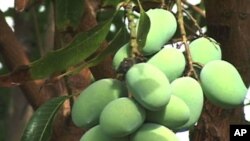
“It’s the shell of a coconut, or the pit of a mango. And these are generally thrown out.”
Though you can’t eat it and you can’t feed it to livestock, DeBolt says a coconut shell or mango pit has a lot of energy in it.
“It compares roughly to low- to moderate-grade coal in its heating value," he says, "which is excellent.”
The same is true for the pit of an olive, peach or cherry, or the shell of an almond or walnut. All that is needed is a way to release the energy.
Turning rice hulls into electricity
DeBolt says a company in India called Husk Power is using small generators in local villages to turn rice hulls into electricity. They use a process called gasification: heating plant matter in a low-oxygen chamber releases gases that can be burned in an engine that spins a power-generating turbine.
DeBolt says his team saw the possibilities for coconut shells and mango pits.
“Hey, well these crops are growing here and these are the areas where there is potential for energy poverty to be alleviated at least in part by these small-scale production systems.”
In a new study in the Proceedings of the National Academy of Sciences, DeBolt and his colleagues used some rough calculations of coconut, mango and other fruit production and the efficiency of the gas generators. And they found in a country like Indonesia, for example, these systems could provide as much as 13 percent of the national energy needs.
Sustained energy supply
“If that’s concentrated on rural, decentralized facilities - not the big cities, which generally have a sustained energy supply - then it may have a more sustained impact on those communities.”
Other tropical countries with significant crops of coconuts, mangoes or other similar fruits could benefit, too.
However, DeBolt cautions that it is not a cure-all. There are technical issues, including how to safely handle the hazardous waste by-products of gasification. And startup funds can be hard to come by in the countries that could most benefit.
Still, he sees potential for coconut power to at least help in alleviating rural poverty.