



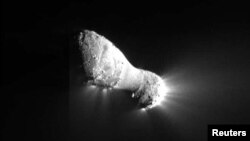
A team of scientists has discovered six exocomets outside our solar system.
Research astronomer Barry Welsh at the University of California, Berkeley Space Sciences Laboratory looks for these comets spinning in elliptical orbits around distant stars, leaving their trademark trails of star-lit gas and debris.
The icy dirt balls - between just five kilometers and 20 kilometers across - emerge from massive discs of gas and dust around the stars, the raw material for new planets. Welsh said the exocomets are formed from these scraps left over from planet formation.
“This is like the missing link, the missing piece in the puzzle. And it reinforces all the planetary formation theories because all the planetary formation theories say you should end up with left-over comets and left-over big hunks of rock, asteroids, and that sort of thing,” he said.
At the American Astronomical Society's meeting in Long Beach, California, Welsh reported that he and his colleagues found spectrographic signatures of the six new exocomets orbiting six very young type-A stars, which are only about 5 million years old.
Although not all the stars harbor exoplanets, the debris disk means they could be present. Welsh said it suggests that across the universe, exoplanets and exocomets co-exist, as they do in our own solar system. “It looks as though they are quite common things.”
Welsh said that if, as experts theorize, comets could have seeded the primordial earth with organic carbon material and water, then comets also may be the key to life elsewhere in the universe. “If comets are universally distributed around, then you could say that the incidence of life could be higher on other planets than we ever thought.”
Back in our own solar system, comets continue to put on celestial shows for Earth-bound observers. People in the northern hemisphere will be able to see an unusual comet in late November of this year, with the highly anticipated appearance of Comet ISON. The newly-discovered comet is predicted to shine as brightly in the night sky as the full moon.
Research astronomer Barry Welsh at the University of California, Berkeley Space Sciences Laboratory looks for these comets spinning in elliptical orbits around distant stars, leaving their trademark trails of star-lit gas and debris.
The icy dirt balls - between just five kilometers and 20 kilometers across - emerge from massive discs of gas and dust around the stars, the raw material for new planets. Welsh said the exocomets are formed from these scraps left over from planet formation.
“This is like the missing link, the missing piece in the puzzle. And it reinforces all the planetary formation theories because all the planetary formation theories say you should end up with left-over comets and left-over big hunks of rock, asteroids, and that sort of thing,” he said.

At the American Astronomical Society's meeting in Long Beach, California, Welsh reported that he and his colleagues found spectrographic signatures of the six new exocomets orbiting six very young type-A stars, which are only about 5 million years old.
Although not all the stars harbor exoplanets, the debris disk means they could be present. Welsh said it suggests that across the universe, exoplanets and exocomets co-exist, as they do in our own solar system. “It looks as though they are quite common things.”
Welsh said that if, as experts theorize, comets could have seeded the primordial earth with organic carbon material and water, then comets also may be the key to life elsewhere in the universe. “If comets are universally distributed around, then you could say that the incidence of life could be higher on other planets than we ever thought.”
Back in our own solar system, comets continue to put on celestial shows for Earth-bound observers. People in the northern hemisphere will be able to see an unusual comet in late November of this year, with the highly anticipated appearance of Comet ISON. The newly-discovered comet is predicted to shine as brightly in the night sky as the full moon.