


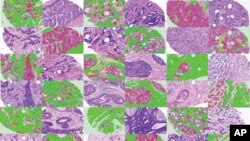
Cancer treatment might have just taken a big leap into the computer age. Stanford University researchers are reporting significant success in training computers to analyze microscope slides of breast cancer biopsies with a keener eye than any human pathologist.
Since the early 20th century, pathologists have been squinting into microscopes, looking for a handful of features in biopsied tumor samples that enable them to classify how aggressive the cancer is.
That information helps doctors decide how to treat a patient.
Today, armed with sophisticated software, powerful computers are getting quite skilled at pattern recognition. Identifying faces, for example. The Stanford researchers thought computers might be able to learn to evaluate cancer biopsies, too.
To do that, Daphne Koller and her colleagues started with a set of biopsy slides that are used to train pathologists. The slides were scanned into the computer, which measured not just the handful of features a human pathologist might review, but thousands of characteristics on each image.
"And we plugged it into a machine-learning algorithm that looked at survival data," she said, "and tried to figure out which of those features were good features in terms of survival, which were bad features, and which were not relevant at all."
In fact, Koller says, the system identified previously unrecognized features on the biopsy slides that help predict how aggressive the cancer will be.
"It turned out that some of the most significant features were in parts of the tumor that pathologists don't look at at all right now."
After the training phase, "C-Path" (Computational Pathologist) evaluated a second set of pathology slides, which came from a different hospital and which were medically and demographically different from the training group. It actually did better than human pathologists, although Koller stresses that C-Path is not designed to replace doctors looking through microscopes.
She says the computerized system could have its biggest impact in resource-poor settings - in developing countries, for example - where skilled pathologists are in short supply.
"Our technology can be easily applied even over the Web, where a local physician extracts a sample and puts it on a slide and scans it into a computer and sends it over the net, and out comes a prediction about survival and ultimately other aspects of the sample that can help guide treatment."
Koller and her colleagues describe the computerized pathologist system in Science Translational Medicine. They're currently working to extend the computerized pathology system to other cancers. It is still some years away from use in patient treatment.