News / Africa

Conde Wins Guinea Presidential Election

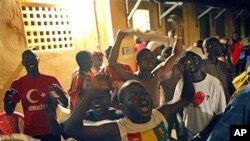
Supporters of Guinean presidential candidate Alpha Conde celebrate at his headquarters after it was announced by the National Independent Electoral Commission that the preliminary results showed he had won Guinea's tense presidential election, 15 Nov 2010

Multimedia

Audio
TEXT SIZE - +

Guinea's electoral commission said long-time opposition leader Alpha Conde has won the country's first democratic vote. Meanwhile, supporters of the losing candidate clashed Monday with riot police.

Electoral commission president Siaka Toumany Sangare said Mr. Conde won more than 52 percent of the vote, while his challenger - former Prime Minister Cellou Diallo - won 47 percent.

Sangare declared Mr. Conde the provisional winner of last Sunday's run-off election, pending certification of the results by Guinea's supreme court. Conde supporters celebrated the win after their candidate had trailed Mr. Diallo during a week of provisional results, slowly tightening the race from 100,000 votes to 50,000 votes to fewer than 24,000 votes before finally finishing ahead.

Many Diallo supporters were angry about the outcome.

Earlier Monday, when the results were widely known, but had not been officially announced, Diallo supporters burned tires in one of the capital's main streets and threw stones at riot police near Conakry's Hamdallaye Mosque. Security forces responded with tear gas, chasing demonstrators from a gasoline station into neighborhoods where they fired more tear gas.

Guinea's military rulers have banned all public demonstrations.

Before the announcement of final results late Monday, both candidates declared themselves the winner.

Mr. Conde won four of five communes in the capital, all but one of the prefectures in lower Guinea, all of the prefectures in the forest region and all of the prefectures in upper Guinea. He said everyone in Guinea knows who won the election.

Mr. Diallo withdrew his party from vote counting on Sunday, saying it had evidence of widespread fraud.

On Monday, Mr. Diallo said that because the electoral commission had not annulled results, which he said were fraudulent, his campaign removed those results itself and found him to be the winner.

Mr. Diallo likely will appeal the results of the vote before Guinea's supreme court.

The election is meant to return the country to civilian rule, nearly two years after soldiers took power here.


You May Like

Experts Weigh In on Challenges of Closing Guantanamo Prison

Former chief military prosecutor at Guantanamo delivers petition to White House with more than 370,000 signatures, demanding facility be closed down immediately More

Karzai to Discuss Enhancing Defense Ties with India

Afghanistan looking for more military aid as it prepares for withdrawal of NATO forces by next year More

India, China Pledge to Overcome Border Tensions

Indian prime minister and Chinese premier attempt to move past tense standoff in the Himalayas during Delhi talks More

Burmese President Opens US Visit with VOA Town Hall Meeting

Ahead of his meeting with President Obama Monday, Thein Sein answered questions on human rights and economic development in his country More

This forum has been closed.
Comments
     
There are no comments in this forum. Be first and add one

Featured Videos

Your JavaScript is turned off or you have an old version of Adobe's Flash Player. Get the latest Flash player.
Video

Video US Oil Surge Could Impact Mideast Geopolitics

The United States will account for a third of new oil supplies over the next five years, and will become energy self-sufficient in 20 years, according to a new report by the Paris-based International Energy Agency (IEA). Although U.S. oil imports from Arab Gulf countries increased last year, analysts predict the U.S. will lose its dependence on Middle East imports, which is expected to have a huge impact on international relations and the balance of power. VOA's Henry Ridgewell reports.