


Egyptians go to the polls Saturday and Sunday in a polarizing presidential race already fraught by controversial court decisions. Whoever wins the runoff will preside over a country with neither a constitution defining his powers, nor an effective legislative branch to act as a check.
Lines formed outside polling stations Saturday amid tight security.
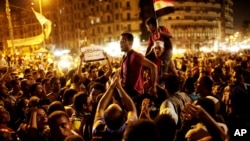
Tensions were high on the eve of the presidential vote, with anger directed squarely at the nation's ruling military council.
Demonstrators have taken to the streets decrying Thursday's constitutional court decision to let Egypt's last prime minister, former Air Force commander Ahmed Shafiq, stay in the race, despite a law banning ex-officials from taking part.
Demonstrator Iman Ibrahim says she would sacrifice her life before seeing a return to politics of the past. She says the nation will not return to the “bottle” the interim military rulers want to imprison them in. “Forget it, military council” she says, “Egyptians have woken up.”
Ibrahim says she will vote for Mohamed Morsi of the Muslim Brotherhood, not that she likes him or his organization, but because at least, she believes, he offers some alternative.
Others look at the choice and also see limitations. But like Mona Makram Ebeid, a lecturer at the American University in Cairo, they view Shafiq as a safeguard of civil society against Islamist inroads.
"I think that Shafiq will be an excellent statesman," she said. "He will not be the man of the regime the people think of. ... He is looking forward; he is looking to the future. He is giving hope to the young people no matter how suspicious they are of him."
But a parallel decision by the court Thursday to disqualify one-third of parliamentary seats has also raised concerns. The court says this means the dissolution of the Islamist-led legislative body. Lawmakers are contesting the ruling, which also disrupts the writing of a new constitution.
American University in Cairo professor Said Sadek believes this has long been the plan of the military council, now apparently in charge of drafting the next basic law.
“If it's Shafiq, [who wins] then they can play with the constitution and will give a lot of power to the president," he said. "If it's Morsi, they will not give him the same prerogative. They will make him a very weak president. He will not be able to influence the institutions, the well-established institutions and the ruling elites in all the Mubarak system who had not been touched yet."
The Supreme Council of the Armed Forces has promised to hand over control to a civilian government by the end of the month. But suspicions it will continue to play a major role either on stage or behind-the-scenes have many worried.
Protester and labor union member Adel Qandil says he feels like he is watching the last act of a play, written by the military when it took over from the old government last year. He says the military is “laughing at all of us,” at turns portraying the protesters in a bad light, then the Muslim Brotherhood, “pitting the whole nation against one another.”
Qandil vows to begin a protest vigil outside the presidential palace if Shafiq wins the election.
But even those critical of the military council voice doubts that the revolutionary spirit of early last year can be revived.
"The military has played an incredibly destructive role in terms of the potential for Egypt's transition and I am not sure to what extent that early momentum of the first month can be recaptured - because we could see Egypt restabilizing in a new kind of authoritarianism that is slightly more open, but still the fundamental structure will remain in place," said Heba Morayef, a researcher at Human Rights Watch in Cairo.
Political observers are concerned that even if Shafiq wins the race fairly, suspicions raised by this week's events would shadow his presidency and cause additional unrest.
But as one activist commented online in the wake of the court rulings, “We'd be outraged if we weren't so exhausted.” After 16 months of instability, the weariness is shared by many.
Lines formed outside polling stations Saturday amid tight security.
Tensions were high on the eve of the presidential vote, with anger directed squarely at the nation's ruling military council.
Demonstrators have taken to the streets decrying Thursday's constitutional court decision to let Egypt's last prime minister, former Air Force commander Ahmed Shafiq, stay in the race, despite a law banning ex-officials from taking part.
Demonstrator Iman Ibrahim says she would sacrifice her life before seeing a return to politics of the past. She says the nation will not return to the “bottle” the interim military rulers want to imprison them in. “Forget it, military council” she says, “Egyptians have woken up.”
Ibrahim says she will vote for Mohamed Morsi of the Muslim Brotherhood, not that she likes him or his organization, but because at least, she believes, he offers some alternative.
Others look at the choice and also see limitations. But like Mona Makram Ebeid, a lecturer at the American University in Cairo, they view Shafiq as a safeguard of civil society against Islamist inroads.
"I think that Shafiq will be an excellent statesman," she said. "He will not be the man of the regime the people think of. ... He is looking forward; he is looking to the future. He is giving hope to the young people no matter how suspicious they are of him."
But a parallel decision by the court Thursday to disqualify one-third of parliamentary seats has also raised concerns. The court says this means the dissolution of the Islamist-led legislative body. Lawmakers are contesting the ruling, which also disrupts the writing of a new constitution.
American University in Cairo professor Said Sadek believes this has long been the plan of the military council, now apparently in charge of drafting the next basic law.
“If it's Shafiq, [who wins] then they can play with the constitution and will give a lot of power to the president," he said. "If it's Morsi, they will not give him the same prerogative. They will make him a very weak president. He will not be able to influence the institutions, the well-established institutions and the ruling elites in all the Mubarak system who had not been touched yet."
The Supreme Council of the Armed Forces has promised to hand over control to a civilian government by the end of the month. But suspicions it will continue to play a major role either on stage or behind-the-scenes have many worried.
Protester and labor union member Adel Qandil says he feels like he is watching the last act of a play, written by the military when it took over from the old government last year. He says the military is “laughing at all of us,” at turns portraying the protesters in a bad light, then the Muslim Brotherhood, “pitting the whole nation against one another.”
Qandil vows to begin a protest vigil outside the presidential palace if Shafiq wins the election.
But even those critical of the military council voice doubts that the revolutionary spirit of early last year can be revived.
"The military has played an incredibly destructive role in terms of the potential for Egypt's transition and I am not sure to what extent that early momentum of the first month can be recaptured - because we could see Egypt restabilizing in a new kind of authoritarianism that is slightly more open, but still the fundamental structure will remain in place," said Heba Morayef, a researcher at Human Rights Watch in Cairo.
Political observers are concerned that even if Shafiq wins the race fairly, suspicions raised by this week's events would shadow his presidency and cause additional unrest.
But as one activist commented online in the wake of the court rulings, “We'd be outraged if we weren't so exhausted.” After 16 months of instability, the weariness is shared by many.