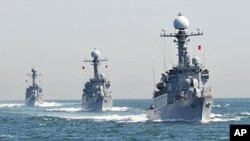



South Korea's military remains on heightened alert following North Korea's threats to launch all-out war. Pyongyang disputes the results of an international investigation that found it responsible for the sinking of the South Korean navy ship. Despite the tensions, there are many in South Korea pushing to change its conscription law, to allow conscientious objectors to avoid obligatory military service.
30-year-old Catholic newspaper reporter Go Dong-ju says his faith is an important part of his life and is the reason he has refused to serve in the South Korean military. That decision got Go sent to jail for a year and a half.
Go met a lot of other conscientious objectors while in jail. Most were Jehovah's Witnesses, 70 to 80 of them, and a few others were not religious but did not want to go to the army.
But not everyone here who avoids mandatory military does so on religious or moral grounds.
Some athletes and entertainers make headlines here for faking disabilities that disqualify them from serving. Recently members of a break-dancing troupe were arrested for pretending to have mental disorders.
Nearly 1,000 men were arrested for avoiding military service last year, according to South Korea's National Police Agency. Despite calls from a United Nations human rights committee, South Korea does not exempt conscientious objectors from military duty. It does, however, allow some to serve in non-combat roles as soldiers in the military.
Choi Jung-min, from the group Korea Solidarity for Conscientious Objection, hopes the government eventually will change the conscription law. South Korea needs a strong military, said Choi, but adds the army is operating on a 60-year-old model. Choi believes her country does not need such a big military and, more importantly, that service should be voluntary.
Some security experts agree.
As the South Korean military adopts more high-tech systems, there is a growing need for professionally trained troops who go on longer tours of duty says Daniel Pinkston, a senior analyst at the International Crisis Group in Seoul.
"Under the current conditions where everyone has to serve for a short term, for some of these systems, that's not really enough time to become highly skilled, professionals," Pinkston said. "You need a core of non-commissioned officers and career officers to operate these types of systems."
Military advisers to the South Korean president agree that reform is needed, but doing away with a conscript army is not an option. Currently, South Korea has an active duty military of about 600,000. Neighboring North Korea has more than one million troops in uniform, and hundreds of thousands of reservists.
Hong Doo-seung serves on a defense panel that was formed in response to Pyongyang's sinking of a South Korean navy ship in March. He said if conscription ended then the military would not represent the entire population. Men from the upper class would not volunteer for service. According to Hong, 85 percent of conscripted soldiers are college educated, which he said is a great resource for the South Korean military, when compared to other volunteer armies.
However, many young men from wealthy or prominent families avoid service by extending their enrollment in foreign universities and by obtaining foreign citizenship or residency.
Hong does not think draft dodgers hurt the military's capabilities, but they do set a bad example, adding that service is still a rite of passage for men and career options are limited for those who do not fulfill their duty.
Conscientious objector Go Dong-Ju says he has had a hard time fitting in with others who have completed their military service and some older Koreans look down on him. He also has had difficulty applying for foreign visas because he has a criminal record for avoiding the draft. Although he does not regret refusing to serve, he would not recommend it to everyone, said Go. A person must be able to endure jail time and understand that he may be labeled a criminal for the rest of his life.
He said he understands that ending the conscription law will be difficult, especially now with the rise in tensions on the Korean peninsula. But Go hopes there can be some compromise or alternative so that conscientious objectors do not have to go to jail.
Conscientious Objectors Call for End to South Korea's Military Conscription Law