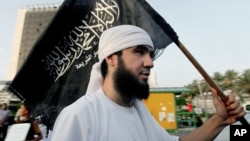
Libyan follower of Ansar al-Shariah Brigades chants as he carries the Brigades flag, with Arabic writing that reads, "There is no God but Allah and Muhammad is his messenger, Ansar al-Shariah," during a protest in front of the Tibesti Hotel, in Benghazi,
Diplomats were urging Libya’s new rulers as long ago as last summer to move quickly on deciding the process for drafting a new constitution. But six months after the country held an election in July, the first one in half-a-century, nothing has happened.
Slow process
Libyans are frustrated by the slow pace of change in the country and say the delay on the constitution isn’t helping the central government to persuade tens of thousands of rebel militiamen to lay down their arms.
One of the biggest holdups on deciding how to go about writing a new Libyan constitution is disagreement about whether the members of a 60-strong drafting panel should be elected or appointed by the country’s new parliament, the General National Congress.
Another is that politicians can’t agree on how to make the process inclusive to ensure that Libya’s three regions - and women - have an opportunity to shape the constitution.
Alexander Graf Lambsdorff, a German member of the European Parliament who headed an observation team to Libya, says speed is now important.
"The decision on the procedure for the selection of the members of the constitutional committee must urgently be made. The continued success of the transitional Libya depends on this committee’s work," he said.
No representation
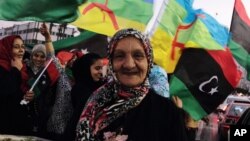
Libyans celebrate one year on since the country was declared liberated from former dictator Moammar Gadhafi, at Martyrs Square in Tripoli, Oct. 23, 2012.
Women fear they will have little influence on a draft constitution that has to be voted on in a referendum before it can become the law of the land. They are insisting they have fair representation on any drafting panel, however it is chosen.
"We therefore believe that it should be inclusive and that means having women on the committee. We believe that is the best way to arrive at a constitution that commands the broad support of all sections of society," said Lambsdorff.
Diplomats and international legal experts say for the process to be inclusive there must be plenty of time for Libyans to have a chance to make their views known to the panel - and that alone could take three months.
“The more pragmatic way is to organize a broad public consultation process prior to the official start of the committee’s work. That public consultation process could easily be three months and would allow regional interests to be voiced, civil society interests to be voiced and women’s interests to be voiced," said Lambsdorff.
Egyptian example
Women activists warn that Libya’s government should not follow the example of President Mohamed Morsi in neighboring Egypt, where a rushed process led to accusations of a lack of inclusiveness and prompted a violent standoff last year.
Former Tripoli school principal and political activist Lutfia al- Tabib says some Libyan men claim they know about women’s rights and what’s best for women. She disputes a notion that there don’t have to be women on the committee.
"At least 35 percent of the committee should be women," she said.
Women parliamentarians have now formed a cross-party bloc with the aim of ensuring fair female representation on the constitutional drafting committee. But the extent of their participation remains in hot debate.