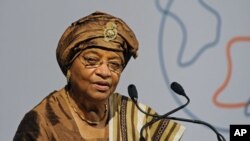
Fighting corruption in Liberia is a big issue in the presidential campaign. The head of Liberia's anti-corruption commission is asking for direct prosecutorial powers to go after government officials misusing public funds.
Campaigning for re-election, President Ellen Johnson Sirleaf says her government's fight against corruption has helped restore investor confidence in a country still recovering from 14 years of conflict.
“We are showing the world that Liberia can become a post-conflict success story," said Sirleaf. "Negative perceptions about us have given way to international respectability. Investors have come in large numbers to invest their resources in our country.”
Political challengers question the president's commitment, saying her government has too much influence over what should be independent investigations. Acarous Gray is the secretary general of the main opposition Congress for Democratic Change.
“The General Auditing Commission does not have to wait to audit the executive arm of government upon the request of the president. No. We want to give them greater autonomy to go in early and not be restricted,” said Gray.
Jerome Verdier led Liberia's Truth and Reconciliation Commission. He said continuing corruption risks reigniting conflict among a population desperate for the rule of law.
“Corruption is a very, very serious issue. And if it continues, I am convinced the people of Liberia will take matters into their own hands," said Verdier. "Because if they don't trust the courts, they don't trust the elites, the political elites, what next?”
Attorney Frances Johnson-Allison chairs the Anti-Corruption Commission. She said the commission's work is frustrated by a shortage of lawyers and its limited legal powers.
“We don't have subpoena powers. So as we investigate cases, if we ask them to come and bring [documents] and they don't come, we stop there," said Johnson-Allison. "We can't go to court because the court will tell us, 'We can not subpoena instruments unless there is a case pending before us.'”
Johnson-Allison is asking lawmakers to give the commission direct prosecutorial powers.
“When we investigate, we must submit to the Ministry of Justice the findings with recommendations for prosecution. And if they don't within three months, we can go to court. But the obstacle has been that we don't have lawyers to take up our cases,” she said.
Johnson-Allison said Liberia's fight against corruption is limited not only by restrictions on her commission but by what she says is a lack of public commitment, as well.
“The social attitudes of people, I don't know if they are ready to fight corruption. I see ambivalence. Certain people, you prosecute and you bring to book and there is an outcry. Others, it's okay. So sometimes we are confused as to what to do, whether we as Liberians really want to fight corruption,” said Johnson-Allison.
Joe Pemagbi is the Liberia coordinator for a civil society research group, the Open Society Institute. He said that despite the lack of prosecutions, the Anti-Corruption Commission's investigations do make a difference in fighting corruption.
“The fact that people are being investigated, sometimes it just serves as a deterrence in a way, the fact that you have been named and shamed. The minute they name you for investigation, that kind of stigmatizes you in a small community like this, so that is a big achievement in its own way,” he said.
But Johnson-Allison said that is not enough.
“We need to go beyond naming and shaming. We need to actually send stronger signals as in prosecution of people,” she said.
She wants the government to establish a separate court to fast-track corruption cases. Liberian lawmakers also are considering a bill that would prohibit judges from granting bail to officials indicted on corruption charges.
Corruption Crackdown Dominates Liberian Presidential Campaign