Court Rules Zimbabwe Too Broke to Hold By-Elections
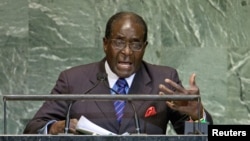
Zimbabwe's President Robert Mugabe addresses the 67th session of the United Nations General Assembly at UN headquarters in New York, September 26, 2012.
HARARE — Zimbabwe's High Court ruled Tuesday that President Robert Mugabe does not have to immediately call by-elections, which a superior court had ordered the goverment to do. The ruling follows Mugabe’s argument the county does not have enough money to run the polls.
The legal battle started after three former members of parliament said Mr. Mugabe was taking too long to call by-elections to fill seats which have fallen vacant since Zimbabwe held its last elections in 2008.
Last week, Mugabe said Zimbabwe cannot afford to hold the elections to fill about 200 vacant municipal and parliamentary seats.
The Supreme Court, which is Zimbabwe’s highest court of law, ruled that Mugabe’s reason for delaying the polls had no legal standing.
However, the High Court said Tuesday that the president has until March 31st to comply with the Supreme Court's order.
Tawanda Zhuwarara, the lawyer for the three former MPs, is not happy with the ruling, and says he wants to appeal.
“Primarily because we believe that the High Court made a gross, gross error of law. Basically we are also of the view that no state can plead poverty and escape its obligations,” said Zhuwarara.
The judge who issued Tuesday's ruling once headed a Mugabe-appointed electoral commission that withheld election results in 2008 for about a month.
That delay was one of several factors that cast doubt on those polls, along with a campaign of violence by Mugabe's ZANU-PF party against supporters of the opposition Movement for Democratic Change.
The parties later formed a unity government under intense pressure from regional leaders.
The scheduling of elections has become the latest of many issues dividing the coalition partners.
Mugabe and his ZANU-PF party have been pushing to hold general polls in hopes of winning a majority and establishing their own government.
The MDC insists that a new constitution be adopted before the elections take place, in hopes of making the polls free and fair.