



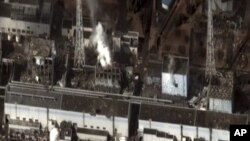
Japan's military failed on Wednesday a first attempt to drop water from helicopters on one of the damaged reactors at its crippled nuclear power plant in Fukushima Prefecture in what officials acknowledge is a desperate move to try to stem radiation leaks from the facility.
In a risky mission, Japan's military tried to air drop the water on the plant's damaged reactors to try to cool radioactive fuel rods. But the helicopters were called back. The Defense Ministry says the radiation level was too high.
Officials turned to the helicopter strategy after rising radiation levels forced the plant's operators to order a temporary evacuation of the last remaining staff, who had been working urgently to pump seawater over the fuel rods to keeping them from melting down with potentially catastrophic consequences.
Japan may turn to US
Japan's government said it might need the help of U.S. military forces to halt continuing radioactive emissions from a nuclear-power plant severely damaged by last Friday's tsunami, triggered by the magnitude 9.0 earthquake.
Watch William Ide's report on the severity of the nuclear crisis
Chief Cabinet Secretary Yukio Edano told reporters that the containment vessel of Reactor 3 at the Fukushima-1 nuclear power plant may have cracked.
The top government spokesman said it is highly probable this may be the source of a cloud of white smoke being seen in video images relayed from a helicopter 30 kilometers away from the crippled nuclear facility.
Reactor 3 earlier suffered an explosion after difficulty in cooling the fuel rods.
Earlier in the day, Tokyo Electric Power Company spokesman Hajimi Motojuku acknowledged the possibility that spent fuel rods at the number-four reactor at the same plant could again enter a state of a nuclear chain reaction.
Motojuku said a fire was again spotted coming from the reactor's spent-fuel cooling pond for about 30 minutes early Wednesday. He says the cooling-pond water may be boiling off, exposing the rods again to the atmosphere.
That would mean the rods would emit radioactive substances into the environment.
The fire was originally spotted Tuesday, apparently triggered by a hydrogen explosion. But Tokyo Electric said they halted fire-fighting operations late in the day because workers believed the flames had been extinguished.
Radiation leaks continue
Radiation levels are so dangerous on the ground at the Fukushima-1 plant that workers have had to give up trying to pour water into the cooling pool and all of the facility's 800 workers have evacuated the site.
Two reactors at the plant apparently suffered partial melting of their cores when the normal cooling functions ceased following last Friday's tsunami triggered by the quake. That is believed to be at least partly responsible for soaring background radiation levels deemed dangerous to people who stay at the facility for an extended time.
Quake death toll mounts
The nuclear crisis is distracting Japan's top officials from devoting their time to the unprecedented natural disaster. The confirmed number of dead and missing is above 10,000 in this part of the country. But local and regional officials say there may be many thousands more people buried in debris following Friday's earthquake and tsunami that washed out an uncertain number of coastal communities.