While the eyes of many Americans have been on the presidential nominating conventions, the United States is continuing to make its mark in space.
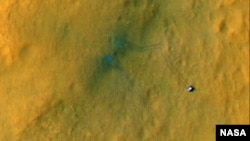
The U.S. space agency NASA Thursday released satellite photos showing track marks left on Mars by the Curiosity robotic rover.
In the one month since it landed, Curiosity has zig-zagged its way across 109 meters of the Martian surface (about the length of a U.S. football field.) It is looking for evidence in the Martian soil and rocks that the planet could have supported life.
Other rovers have left track on Mars but NASA says Curiosity's are the first that can be seen from far overhead.
On Wednesday, NASA said its Dawn spacecraft had left the Vesta asteroid and is headed toward the dwarf planet Ceres. Dawn is helping scientists learn about about the universe was formed.
NASA says Dawn is expected to reach Ceres in early 2015.
The U.S. space agency NASA Thursday released satellite photos showing track marks left on Mars by the Curiosity robotic rover.
In the one month since it landed, Curiosity has zig-zagged its way across 109 meters of the Martian surface (about the length of a U.S. football field.) It is looking for evidence in the Martian soil and rocks that the planet could have supported life.
Other rovers have left track on Mars but NASA says Curiosity's are the first that can be seen from far overhead.
On Wednesday, NASA said its Dawn spacecraft had left the Vesta asteroid and is headed toward the dwarf planet Ceres. Dawn is helping scientists learn about about the universe was formed.
NASA says Dawn is expected to reach Ceres in early 2015.