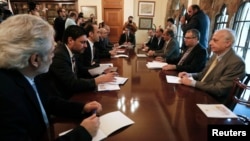
Cypriot leaders held crisis talks Wednesday and the leader of Cyprus's Orthodox Church has offered church assets to help after the Cypriot parliament overwhelmingly rejected a bailout plan on Tuesday.
Archbishop Chrysostomos said Wednesday the church is willing to mortgage its assets and invest in government bonds. He made the comment after a meeting with President Nicos Anastasiades.
On Tuesday lawmakers overwhelmingly rejected a $13 billion bailout plan demanded by international lenders that would have taxed the savings accounts of depositors at the island nation's banks and produced nearly $11 billion.
The vote left the fate of the bailout in question and raised the possibility that the Cypriot government could default on its financial obligations or even end its membership in the 17-nation euro currency union.
Cyprus, a longtime offshore tax haven, had sought to use much of the bailout to refund its beleaguered banks that have been weighed down with losses from bad loans.
But the bailout terms - set by the International Monetary Fund, the European Central Bank and Cyprus' eurozone neighbors - called for the tiny country to impose what they said was a one-time tax on bank deposits, nearly 10 percent on the largest accounts above $130,000.
The proposal drew the immediate ire of Cypriots, as well as Russian President Vladimir Putin. Russian oligarchs have vast sums parked in Cypriot accounts.
The Cypriot economy accounts for only a very small fraction of the eurozone's economic fortunes, but none of the previous bailouts for Greece, Portugal, Ireland and the Spanish banking system has taxed savings. Some analysts said they fear that taxing deposits in Cyprus could set a precedent that might be followed in other debt-ridden countries in the union and ignite a run on banks to withdraw money.
Archbishop Chrysostomos said Wednesday the church is willing to mortgage its assets and invest in government bonds. He made the comment after a meeting with President Nicos Anastasiades.
On Tuesday lawmakers overwhelmingly rejected a $13 billion bailout plan demanded by international lenders that would have taxed the savings accounts of depositors at the island nation's banks and produced nearly $11 billion.
The vote left the fate of the bailout in question and raised the possibility that the Cypriot government could default on its financial obligations or even end its membership in the 17-nation euro currency union.
Cyprus, a longtime offshore tax haven, had sought to use much of the bailout to refund its beleaguered banks that have been weighed down with losses from bad loans.
But the bailout terms - set by the International Monetary Fund, the European Central Bank and Cyprus' eurozone neighbors - called for the tiny country to impose what they said was a one-time tax on bank deposits, nearly 10 percent on the largest accounts above $130,000.
The proposal drew the immediate ire of Cypriots, as well as Russian President Vladimir Putin. Russian oligarchs have vast sums parked in Cypriot accounts.
The Cypriot economy accounts for only a very small fraction of the eurozone's economic fortunes, but none of the previous bailouts for Greece, Portugal, Ireland and the Spanish banking system has taxed savings. Some analysts said they fear that taxing deposits in Cyprus could set a precedent that might be followed in other debt-ridden countries in the union and ignite a run on banks to withdraw money.