



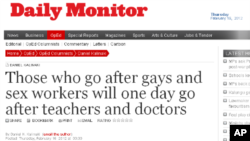
A government raid on a meeting of gay rights activists in Uganda has prompted debate on the country's stance towards homosexuals. Daniel Kalinaki, managing editor of Uganda's Daily Monitor newspaper, spoke with VOA correspondent Gabe Joselow about his recent opinion piece arguing that the threat to gay rights is a threat to justice throughout the country.
JOSELOW: "First of all, the title of your article is 'Those Who Go After Gays and Sex Workers Will One Day Go After Teachers and Doctors.' Can you explain what you mean by that?"
KALINAKI: "What I basically mean is that people need to stand up against injustice, even if it's meted out against people they might disagree with, because injustice creeps up on society, starts with minorities, starts with people who are different from the rest of us all, but eventually it consumes the entire society. And I give examples in the article of people who are like us, you know, they're standing up for basic rights of pay, of work conditions, who have been subjected to the same kind of disruptive interference by state agents as the homosexual community or the gay rights activists in Uganda."
JOSELOW: "And later on you go on to say that regardless of your views on homosexuality, something like the recent raid on gay activists should concern everybody. So, how do you convince someone who is against homosexuality that they should be concerned as well?"
KALINAKI: "Well because you need to separate the moral from the legal. You might have your views about homosexuality, you might detest homosexuality and people who choose to be homosexual, but you must be willing to defend the basic fundamental rights of association of assembly and of expression. Because if they take those rights away from the homosexuals, nothing stops the government from taking those rights away from you. So it starts with people who are easy to isolate and demonize but it eventually - and history is littered with hundreds of examples - it eventually catches up with everyone."
JOSELOW: "Was the recent raid an isolated incident, or part of a bigger pattern in Uganda?"
KALINAKI: "We have seen of course, the gay-bashing in Unganda has been around for a long time and there are people who have very strong views against homosexuality and they are entitled to those views. People who have a problem with homosexuality are as entitled to holding those views as those who think that homosexuals have a right to live their lives as they choose. And that debate needs to take place, but what we're seeing is not just the gay bashing, we're seeing an erosion and the curtailment of civil liberties.
Opposition demonstrations and political rallies have been interrupted. We've seen attempts to influence the content of radio and TV broadcasts as well as print articles, we've seen demonstrations by teachers, by doctors broken up. There is a pattern and I imagine the pattern is the government, where people hold views that are critical of its policies, or views that the government does not agree with, is willing to abuse the constitutional rights of assembly of expression, bringing the law enforcement agencies to actually abuse the law."
JOSELOW: "Now, Uganda has received a lot negative attention from the international community because of an anti-homosexual law being put forward in the parliament. The government's response has been that this is a Ugandan issue, it doesn't concern anyone else. Do they have a point?"
KALINAKI: "A lot of the criticism by the international community has actually been self-defeating. You cannot stop, or you should not condemn those who hold alternative viewpoints. If there are people in Uganda who have strong views against homosexuality, they have the right to be heard they have the right to have their views debated. But the people who say they have the problem with homosexuality do not represent every Ugandan.
Now as a straight Ugandan with a family and a partner I have my views about homosexuality, but I don't think it is my place to determine how the next guy chooses his life and what sexual orientation he chooses. So this needs to be seen as a rights-based issue. The people who try to stop the debate actually force the issue away from a rights-based issue, they lose the moral high ground and they give fuel to homophobic people who say this is something that is being pushed and sponsored by the outside."