



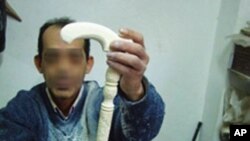
A new report names Egypt as the center of illegal ivory trade and smuggling in Africa. With the political unrest of the Arab Spring, illegal ivory outlets and workshops have done a booming business.
The report, which appears in TRAFFIC Bulletin, said illegal ivory products are readily available in Cairo and Luxor. Co-authors Esmond Martin and Lucy Vigne visited Egypt in March and April of 2011. Martin says there was no attempt to hide any of the ivory.
“We found over 9,000 pieces of ivory in Cairo and in Luxor. Most of it in Cairo. And all of this ivory is of illegal origin. It’s not allowed to be sold. It’s not actually--I don’t think--allowed to even be displayed for commercial purposes,” he said.
He said the 9,000 pieces were only those on display. They did not include any stocks that might be hidden or in storage. He says much of the ivory is shipped through Sudan on its way to Egypt.
“The ivory itself, the tusks, probably came from Central African Republic, the Democratic Republic of Congo, Kenya and the Cote’ D’Ivoire. So those tucks seem to funnel through Sudan and then up into mostly Cairo itself and to a place called Khan al-Khalili, which is the main market,” he said.
China
The report said China is the biggest market for illegal ivory, but much is also smuggled to the Persian Gulf states in the form of prayer beads and walking sticks.
“The Chinese now are the major consumers and buyers of ivory in Egypt. Before it was the French, Spanish and the Americans. But now it’s been superseded by the Chinese, who are probably buying half of all the ivory,” he said.
The ivory smuggling to China is taking a big toll on Africa’s elephant population.
“The Chinese are the biggest importer of illegal ivory in the world. And it’s the single biggest problem concerning elephants in all of Africa and in parts of Asia, but mostly in Africa. So we’ve got to sort this situation out. Lucy Vigne and I were in China last year roughly at this time and we did surveys in the southern part of the country. And we saw a lot more ivory available for sale than there was before. And the price was about $750 a kilo for the raw tucks,” he said.
Martin said there’s no evidence Chinese officials are involved in the ivory trade. In fact, he said the Chinese take the situation very seriously and have harsh penalties for anyone caught with illegal ivory. The problem is there are so many small-scale smugglers in Africa sending ivory to China it’s difficult stop the flow.
What can be done?
Egypt is a member of CITES, the Convention on International Trade in Endangered Species of Wild Fauna and Flora.
Martin said he brought the problem of the illegal ivory trade to the attention of Egyptian authorities and asked them to crackdown.
“When I asked them why they don’t do it they said they have difficulties identifying elephant ivory from camel bone. Other people in the government have told me that they’re a little bit concerned about their security going into these back streets in in this market called the Khan AL-Khalili,” he said.
He said the Egyptian government should conduct raids on the illegal ivory shops.
“If they’re not willing to do that I think that pressure we have is on the tourist industry. In 2010, Egypt had about 13 million foreign tourists. And we could get the tour operators and the tour companies to put some pressure on the Egyptian government to enforce their own laws. Also we can put up posters and give out information within Egypt itself, especially in Cairo, stating that the purchase of the ivory is illegal. The export of it is illegal and the import of it into their home countries is illegal. It’s just an education thing,” he said.
A possible alternative to the elephant ivory, Martin said, is ivory from mammoths, the extinct elephant-like animal with long curved tusks and long hair. Martin says the sale of mammoth ivory is increasing in China. Hong Kong is said to import up to 30,000 kilos of mammoth ivory a year for the past few years.
However, no one knows just how much mammoth ivory is available in Siberia in northeastern Russia. But the trade has sharply increased since the break-up of the Soviet Union.