



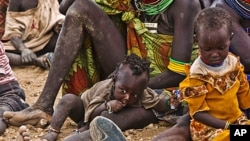
Experts say there was plenty of warning that the Horn of Africa was likely to experience severe drought. Nevertheless, millions of people are now at risk.
Scientific experts have been saying for years that the Horn of Africa was vulnerable. The warning came with recommendations to prevent drought or lessen its effects. But to a large extent, those recommendations remained just that -- recommendations.
Regrets
“Like everyone, we are very much moved by the image and news that we are seeing from not only Somalia, but also the whole Horn of Africa,” said Mansour N’Diaye, chief of cabinet at the Secretariat of the UNCCD – the United Nations Convention to Combat Desertification. He described what’s happening in the Horn as “an illustration of regret.”
“Regret that most of the knowledge that has been accumulated over years, not only from the UNCCD, but also from other relevant international organizations, about drought and how to address the issue of drought. All those. We are unfortunate to say that they are not very much put to the attention of policymakers for them to take preventive measures,” he said.
We warned you
Last January, meteorological experts warned that the Horn of Africa was on the verge of severe drought.
“So no one can say that we didn’t know. It was known, including by policymakers. The fact of the matter is that perhaps priorities were given to something else. And therefore, one has to face the fact that policy failures are here very much at stake,” he said.
And that wasn’t the first warning. The UNCCD official says a warning was issued as far back as 2007 by the Intergovernmental Panel on Climate Change.
N’Diaye said, “Go back to the IPCC report. It was clearly stated by scientists that have studied the issue of climate change that for nearly 10 years areas that are prone to drought – and we are talking about areas like those in the Horn of Africa – will experience more frequent droughts and more intense droughts of a much wider distance. And near droughts will emerge where they never existed before. This is in the IPCC report.”
Has time run out?
Now that drought has firmly taken hold in the Horn of Africa, with famine in parts of Somalia, is it too late to act?
“We cannot say that it’s too late,” he said, “because we have the knowledge as to what is it that one should do to better manage land, including in the dry lands. And therefore the UNCCD is there to facilitate, particularly in countries like those in Africa, precisely the implementation of their action programs to combat desertification.”
N’Diaye said lands affected by desertification can be reclaimed. If they were fertile once, they can be again.
“It takes time,” he said, “but it is time which is valued to be invested in. Because in the end, what is at stake is precisely to improve the livelihoods of those inhabitants from the dry lands, like those in the Horn of Africa.
That investment, he says, requires political will.
Recommendations for dealing with the drought include a political solution to Somalia’s conflict. Also, U.N. Convention to Combat Desertification experts and others call for greater investment in smallholder farms, empowering community-based organizations to manage the land, addressing land ownership and land degradation issues, and rolling out comprehensive national action plans on drought prevention.
In November, talks will be held in Casablanca on creating better ways to share drought information. The meeting is being organized by the UNCCD, the World Meteorological Organization, the U.S. National Integrated Drought Information System and Morocco’s national meteorological service.