


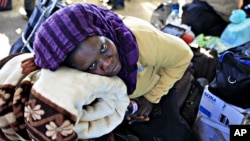
Thousands of sub-Saharan Africans may be too scared to leave Libya. That’s according to the International Organization for Migration (IOM), which said it is “increasingly concerned over the fate of vulnerable migrants.”
The IOM has been evacuating migrants from Tripoli by boat and giving them safe passage to Benghazi.
“We’ve noticed that in our three missions,” said IOM spokesman Jumbe Omari Jumbe, “very few sub-Saharan Africans have managed to come to the port and board our vessels. So we are really concerned. And of course we have a team on the ground now. They report to us that sub-Saharan Africans, in particular, are so afraid to get out because of all the barriers and roadblocks and because of the stories that they have been targeted.”
Targeted?
Since the beginning of the Libyan conflict, there have been reports and rumors that sub-Saharan Africans had been hired by Moammar Gadhafi as mercenaries.
“So they are holed up in various areas and unable to come to the port to board our vessels,” Jumbe said.
As for the rumors, Jumbe said they are still circulating. “We cannot confirm or deny them. Although those migrants who reached Tunisia and other border areas, they told us stories…that they have been targeted. Some of them have been mistreated, maltreated even, particularly along the road when they were fleeing. Most of them have lost their possessions.”
Guesstimates
It remains unclear just how many sub-Saharan Africans remain in Libya.
“We don’t know for sure how many there are. The reason is many of those, particularly from neighboring countries – that is Niger, Mali and other countries – reached Libya in an irregular manner. I mean they have not registered. Some of them have no passport. And because of that they did not obviously go to their embassies to register themselves for fearing that (it) may be negative to them,” he said.
The IOM estimates before the conflict began, there were as many as one million sub-Saharan workers in Libya.
“With all those whom we have evacuated, we are still thinking that thousands of them are still in Libya, maybe 100,000, 200,000. I can’t tell. But thousands of them are still holed up in Libya.
What to do?
The IOM is negotiating with the new authority in Libya, the National Transitional Council, to gain access to the migrants.
“We know that most of them live in the suburbs of Tripoli in private farms, some of them,” he said. For example, on one farm, an IOM team found about 70 migrants, many of them Nigerian.
“They told our team that there are about 450 of their friends and relatives around that area. Many of these are young men, but there are those with families,” he said.
Since evacuating sub-Saharan migrants by boat has so far been unsuccessful, the IOM is also considering evacuating them by road.
“We are thinking seriously about road evacuation because that is cheaper, first, for us and also it is much safer. Because we can just go to the areas where they are, pick them up in our buses and off we go,” said Jumbe.
Before fighting reached Tripoli, there had been evacuations by land.
“These were largely organized by the diplomatic missions,” he said, “but not sub-Saharan African countries. So this time we want to do the evacuation, road evacuation, by ourselves, with IOM buses.”
Meanwhile, the IOM has so far evacuated about 1600 people from Tripoli in three separate boat missions. But it says there’s a growing sentiment among some migrants that the situation in the country is growing more stable, so they’ve chosen to remain in Libya.