



The winner of the 2010 World Food Prize says eradicating hunger is within reach. The comment came as the United Nations prepares to hold its summit next week (9/20-22) on the Millennium Development Goals.
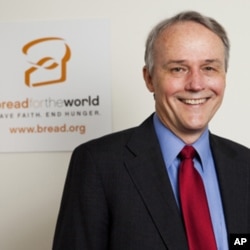
Rev. David Beckmann says he’s encouraged by efforts to achieve the MDGs – especially the first goal, to eliminate extreme poverty and hunger.
“I take a lot of encouragement from the fact that the world’s been making some progress against hunger, poverty and disease. (We’re) almost surely not going to hit all the Millennium Development Goals in all the countries of the world. But we have seen remarkable progress against hunger and poverty,” he says.
Beckmann, who’s president of Bread for the World, says a lot of progress can be seen in sub-Saharan Africa.
“There are 30 million more kids in school than 10 years ago. Although the rate of hunger is still way too high in Africa, about half the countries in Africa in fact have made really significant progress against poverty over the last 10 years or so,” he says.
Get involved
But he says to eradicate hunger and poverty requires everyone’s participation, starting with world leaders at the U.N. summit.
“It takes political commitment. So it’s good to get all these heads of government to come together in New York because it makes them focus on poor people. The people who run governments have a lot of other pressures and they usually don’t focus on poor people. So, it’s good for them, but it’s also good for us because it makes you and me talk and your listeners listen and think about what can happen to reduce poverty, hunger, disease. Because I think a lot of the action really is in our hands,” he says.
The U.N. summit will also be used to launch a global campaign to end childhood hunger and malnutrition. Some are calling it the thousand day campaign. Beckman says recent studies have shown the importance of good nutrition at a very early age.
“The most important lesson from all these studies is…that to have a high impact you’ve got to focus on babies and pregnant women. So the thousand days between conception and age two. That’s the highest impact time to make sure that a child has good food, enough food, good nutrition. If we miss that window, the child’s health and intellectual capacity will be less for the rest of his or her life,” he says.
Not just a job
For Beckman, the effort to eradicate hunger and poverty is a spiritual one.
“I’m a preacher, a Christian preacher. So, when I see the fact that hundreds of millions of people have escaped from poverty, I think this is God moving in our time,” he says, adding, “It’s something that we can do that God wants to have happen that, you know, kids ought to have enough to eat. Every kid in the world ought to have enough to eat. That’s actually within reach now over the next couple of decades.”
He says having enough food is a basic human right.