


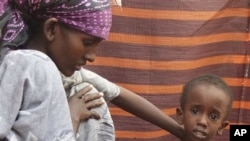
Somalis fleeing drought and famine are seeking shelter in the capital, Mogadishu, as well as in the neighboring countries of Kenya and Ethiopia.
In northeastern Kenya, hundreds of thousands of Somalis are at the Dadaab refugee camps, while in southeastern Ethiopia, many thousands have gathered near the town of Dolo Ado, where there’s an overcrowded transit center. UNHCR and the International Organization for Migration are relocating refugees to nearby camps.
“That’s going very well. We’re on the fifth day of the operation. We’re moving some 15,000 refugees that have been in the transit center to a new camp that was opened on Friday,” said UNHCR spokesperson Milicent Mutuli, who’s in Addis Ababa.
The new camp is located at Hilaweyn. “We’ve been able to move at least a thousand refugees every day,” she said.
The numbers are falling
Fewer Somalis are crossing into Kenya, according to UNHCR.
“The situation in Ethiopia has actually steadied in the last two weeks. Just over a month ago, we had arrival rates of up to 2,000 people per day. But in the last few days, we’ve been seeing an average of 200 to 300 people per day,” she said.
While the numbers of new arrivals are declining, there are many Somalis already in camps in Ethiopia.
“There are still over a hundred thousand people in the camps in Dolo Ado in southeastern Ethiopia. Nearly 80,000 of these people have come in this year alone,” said Mutuli.
Measles
UNICEF and the Ethiopian Ministry of Health are lending support to a vaccination campaign following a suspected measles outbreak among children.
“In general terms,” said Mutuli, “measles is not a killer disease…at least not in a healthy population. However, our big concern here is, apart from the fact that measles is highly contagious, it is in a population that is extremely fragile. It’s in a population where malnutrition rates are extremely high.”
That means the disease could easily become a killer. “Mortality could be very high," she said.
Mutuli said, “One of the challenges in the response to the outbreak is that the refugees are not in the habit of seeking medical attention for the sick.”
She explained, “I think it goes back to Somalia and just the absolute breakdown of services due to 20 years of conflict…. And so when they come into the camps they still are not aware of services that are available and that they can seek consultation for somebody who is sick.”
Somali refugees are being encouraged to bring any sick friends or family members to the camps’ health centers.