



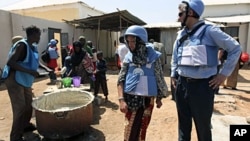
In Somalia, thousands of already displaced people are fleeing new fighting northwest of Mogadishu. Many are heading for the capital where humanitarian agencies are setting up emergency relief operations.
U.N. refugee agency spokesman Andy Needham said more than 7,000 Somalis have left the Afgooye corridor in the last two weeks, more than 5,000 of them in the past few days.
The Afgooye corridor is the largest single concentration of internally displaced people in the world. There are over 400,000 people along a 40 kilometer stretch of road, which snakes out from Mogadishu head eastwards.
It’s where many Somalis from Mogadishu went when intense fighting in the city was a daily occurrence in recent years.
Advanced warning
Needham said civilians did receive a warning of possible violence from the Transitional Federal Government and the African Union mission in Somalia.
“Well, basically in the last number of days, the TFG and AMISOM forces gave an indication to residents within Afgooye corridor that there may be increased military activity in the area. Basically advising people – perhaps for their own safety – to move,” he said.
The UNHCR and other aid agencies are gearing up operations in Mogadishu.
Needham said, “What we will be delivering to those people will be emergency assistance packages. They need again, just as in the case of the famine, very basic items – shelter, food, water – because literally they’re fleeing with their homes and their possessions on their back. And they need to start again or find somewhere to bed down in Mogadishu.”
They’re traveling by foot, donkey and minibus. But not everyone is heading for Mogadishu.
“Often in these situations the Somali people are very resourceful and we are receiving some reports that they may be heading to other villages along the way. So perhaps if this displacement continues in the coming days, we may see also different patterns emerging where they’re going in different directions. That in some sense will ease the influx into the city,” he said.
Overall, the UNHCR estimates there are nearly 1.4 million displaced people within Somalia. There are nearly a million Somali refugees in neighboring countries. Most of the refugees, about a half million, are in Kenya at the Dadaab and Kakuma refugee camps.