



Birds and planes have been colliding since the Wright brothers first took to the air.
There are dozens of bird strikes each day, causing hundreds of millions of dollars in damage to airplanes each year, and putting the lives of passengers and crew members at risk. Researchers at Cornell Lab of Ornithology are now working on a way to help prevent collisions, by deciphering the calls birds use to communicate on their migration routes.
Rosetta Stone for birds
There's more to the language of birds than songs. They also use short calls - less than a second long. And each species speaks its own language.
Ken Rosenberg has been an avid bird-watcher since he was a boy. Today he works at the Cornell Lab of Ornithology, unraveling avian mysteries. He says that birds use these short calls most often during migration.
"What we suspect is that these are calls that the birds are actually using to communicate back and forth, to locate each other," he says. "'Don't crash into me!' Of course, we're guessing, but given the way they call, it's really just a social thing."
Until recently scientists weren't aware of the extent of these calls, because most bird migration takes place at night.
"It really began with amateur bird watchers who were noticing these sounds in the sky and knew that they were birds migrating overhead," says Rosenberg. "A few people became detectives and tried to figure out what these sounds were."
Bird call detectives
The migratory flyways over the United States are crowded with billions of birds every spring and fall.
By aiming special microphones at the night sky during these times and recording the passing calls, scientists realized they could determine what kinds of birds were flying overhead, and learn their migration schedules and flight paths. But there was a lot of sky to cover.
Pat Leonard, also with the lab, says they turned to military bases and amateur birders to help record the sounds. "We couldn't do that any other way if we didn't have everyday birders out there collecting that information for us. There are just too many birds and too many places."

And maybe too much data. Each location recorded eight hours worth of tape nightly, all of which had to be listened to in real time. And many of these short calls sound very similar to the untrained ear.
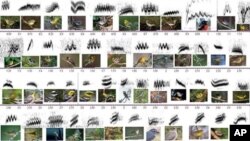
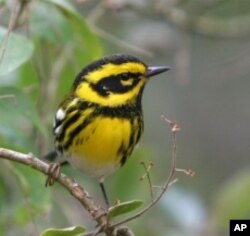
One recording contains the calls of 48 different types of warblers. The Ornithology Lab teamed up with Cornell University's Bioacoustic Research Program to develop software that would decode the birdcalls.
Decoding the calls
The program can isolate the unique characteristics of each thrush species into algorithms much like voice recognition software. After processing, individual calls become more pronounced.
"It still may always take a human to review the results, but it should eliminate all the steps of having to sit and listen and watch the thing go by on the screen," says Rosenberg.
That means more researchers can work on night flight call projects more quickly. That data should reveal what species are flying where and when.
Developing a knowledge base of various migration flight paths and characteristics will help scientists advise airbases and airports of the best routes and times to fly to avoid large flocks of birds.
The information can also impact plans for wind turbine farms and communication towers, so they're not placed where migrating birds will fly into them. And, Rosenberg says, it will help environmentalists better gauge another pressing issue:
"Birds are very sensitive indicators of the health of the overall environment. In terms of their migration, knowing whether the timing of their migration is shifting from year to year is one of the best clues that global warming is actually happening."
A prototype of the software will be ready in approximately a year to 18 months.