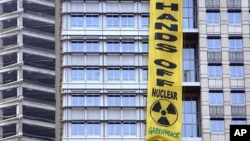
Japan's ongoing efforts to avert the meltdown of two nuclear power plants following major earthquakes and a tsunami have raised renewed concerns about the safety of nuclear energy in other earthquake prone countries, especially Indonesia. Like Japan, earthquakes and volcanic eruptions are common in many parts of Indonesia. In 2010 a small tsunami hit the Mentawai islands on the western side of Sumatra. And the 2004 tsunami that devastated the region from Thailand to Sri Lanka, killed over 160,000 in the northwest Aceh province of Sumatra.
Despite the risks and concerns posed by the nuclear crisis in Japan, Ferhat Aziz, spokesman for the Indonesian National Nuclear Energy Agency, says Indonesia still plans to build nuclear reactors to produce electricity.
"First of all, it is, indeed we are concerned with the event in Japan. Its a tragic one," Aziz said. "As far a Indonesia is concerned we have also to be more concerned about the needs of this country for energy in the near future."
Aziz says to ensure public safety Indonesia will build plants outside of earthquake zones and in accordance with the International Atomic Energy Agency guidelines. But Richard Tanter a nuclear safety and security researcher at the Nautilus Institute in Melbourne says, the proposed site for a nuclear power plant on the Muria peninsula on the north coast of central Java is a high risk location.
"Firstly that was on the edge of a volcano. Secondly there were seismic risks in that area," noted Tanter. "Thirdly planning for that Muria nuclear power plant has been based on Japanese earthquake guidelines of thirty years ago."
Aziz disputes these risks but says the government will likely give in to public pressure and change the proposed site.
"Muria is in Java Island," he explained. "It is actually one of the safest places on Java. It is quite far away from the fault line. It is far away from volcanos. But as for the moment we are kind of pending it now because of the opposition from the people there."
The government had set a goal of building a nuclear power plant by 2016. Finding a new site may make meeting that deadline unlikely.
The islands of Borneo and Kalimatan would be ideal sites from a safety perspective, Aziz says, because they lie outside the fault line known as the "Ring of Fire," where two shelves of the earth's crust meet. Along this juncture heat from the earth's core escapes causing earthquakes and volcanic eruptions. But building nuclear plants on Borneo or Kalimatan would not solve the energy needs of Java, the country's most populous island. Aziz says they are now studying the feasibility of building a nuclear plant on Bangka island off the east coast of Sumatra and run underwater cables to carry the electricity to Java.
Given the risks and the costs, Tanter questions the need for nuclear power in Indonesia, a country already rich in natural gas and coal and has the potential for developing significant geothermal, solar and wind energy. But other countries in the region are also pursuing nuclear power. And Tanter says Indonesia like many countries sees the development of nuclear power as a sign of technological progress and national pride.
"When countries like Malaysia and the Philippines announce their now quite firm intentions to go ahead with nuclear power there is a feeling in some circles in the Indonesian government and in the parliament of a kind of nationalist kind, 'Look we are meant to be the leaders of ASEAN. We are the biggest. We should be the leading part. Why aren't we pursuing this technology as well?" asked Tanter.
In the wake of the disaster in Japan, some officials in Indonesia, Malaysia and the Philippines are urging their governments to re-evaluate the need for nuclear power.
But Aziz says developing nuclear power is not about pride but capacity. Indonesia is the fourth most populous country in the world, and Aziz says it will need all types of power generating plants to meet its growing energy needs. Indonesia already safely operates three nuclear research facilities and he says that public safety will continue to be a priority when building any nuclear power plants.
Despite Japan Crisis, Indonesia Pursues Nuclear Power
- By Brian Padden