Developing Countries Want Rich Nations to Pay for Climate Change
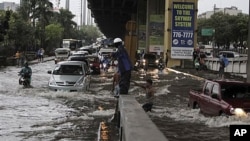
Tropical Storm Aere pounds the Philippines. Developing nations want industrialized countries to increase funding to help them cope with the effects of climate change, including rising sea levels and more violent storms.
The United Nations climate talks in Doha, Qatar, continued into their second week, Wednesday, as delegates from nearly 200 countries struggle to craft a replacement for the Kyoto Protocol, the global agreement on climate change that expires at the end of this month.
The negotiations are deadlocked over demands by poorer nations for financial help in coping with climate change.
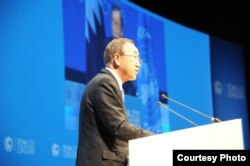
United Nations Secretary General Ban Ki-moon called on delegates at the United Nations Conference on Climate Change to speed up their work on an agreement to address a warming planet.
“Let us be under no illusion, this is a crisis, a threat to us all, our economies, our security and the well-being of our children and those who will come after," he said. "No one is immune to climate change, rich or poor.”
United Nations Secretary General Ban Ki-moon wants delegates at the UN Conference on Climate Change in Doha to speed up their work on an agreement.
Delegates from nearly 200 countries - rich and poor - are in Doha to extend the Kyoto Protocol, the 1997 global climate change agreement that expires at the end of this month, and to begin to forge a new agreement to replace it.
Two issues block the way forward. Developing countries are demanding that industrialized nations fulfill their pledges under Kyoto to reduce their climate-changing industrial emissions of carbon dioxide and other greenhouse gases, and to put new, larger emission curbs on the table.
The developing nations, led by China, are also insisting that rich nations provide more aid to poorer countries to help them cope with the effects of climate change, including rising sea levels and more violent storms.
In Doha Wednesday, Tim Gore, a climate change policy advisor for Oxfam International, a confederation of groups working on social justice issues, applauded efforts by England, Germany and Sweden to increase their climate aid and expects other nations to follow.
“Those announcements are truly welcome. And they shine a spotlight on those that have remained silent: the U.S., Canada, Japan, even Australia," Gore said. "But we need to be very clear as well that those types of announcements made in press conferences can be no substitute for clear commitments in the text that poor countries have come here to negotiate.”
According to Gore, poor countries need funds to help them switch to cleaner energy sources and to adapt to a warmer world.
“We need at a bare minimum to know that the public finance that the developed countries are providing to poor countries to fight climate change increases next year," he said, "and keeps increasing every year until we reach $100 billion by 2020, $100 billion per year by 2020.”
At U.N. Climate talks in 2009, delegates agreed that money would go into a Green Climate Fund. Gore says so far, the biggest players - the United States and the European Union - have not resolved exactly how they will provide the promised dollars. But a U.S. negotiator in Doha says the Obama Administration continues to support climate finance.
United Nations Secretary General United Nations Secretary General Ban Ki-moon urged delegates do resolve the issue.
“For the simple reason that it affects all people increasingly and profoundly. If we act together with a clear purpose, we can meet the challenge," he said. "But we need to be united, governments from all regions, businesses, and civil societies. We have a clear choice: stand together or fall together.””
Ban has been meeting with a group of key countries to emphasize the importance of an agreement on long-term financing. The U.N. Secretary-General said Wednesday that he plans to convene a high-level meeting in 2014 aimed at speeding sluggish international efforts to combat climate change.