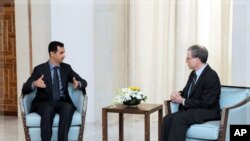
Hours after the U.S. State Department announced that U.S. Ambassador to Syria Robert Ford had returned to Washington as a result of security threats, the Syrian embassy in Washington said its ambassador, Imad Moustapha, was returning to Damascus.
Both the U.S. ambassador to Syria and the Syrian ambassador to the U.S. have been recalled to their capitals, and officials on both sides say the respective recalls are for consultations. But State Department officials also say Ford was brought back to Washington as a result of "credible threats" to his safety.
Speaking to reporters in Washington Monday, State Department spokeswoman Victoria Nuland underscored that Ford's return to Washington is not a withdrawal. She also accused the Syrian government of engaging in a "smear campaign" against the U.S. diplomat.
"We are concerned about a campaign of regime-led incitement targeted personally at Ambassador Ford by the state-run media of the government of Syria, and we're concerned about the security situation that that has created," she said.
Nuland said Ford is expected to return to Damascus after his consultations are completed, although the timing is uncertain. She said the Syrian government must provide for Ford's security when he returns.
Ford, a career diplomat, was appointed U.S. ambassador to Syria in January. He has served in Algeria, Bahrain and Iraq within the past decade.
Salman Shaikh, who specializes in conflict resolution issues in the Middle East, is the director of the Brookings Doha Center. He told VOA that Syrian media have tried to portray Ambassador Ford's work in Iraq in an unfavorable light. "I think it's an effort to try to paint him into some sort of a sectarian picture as well, to capitalize on perhaps some of the sectarian issues that have come to the fore in Iraq and to try and, not so subtly, link them with sectarian issues in Syria itself," he said.
Ford has been an outspoken critic of the Syrian government's violent crackdown on political dissent. The United Nations says 3,000 people have been killed since the uprising against Syrian President Bashar al-Assad's government began in March.
Ford's stance has agitated the Syrian government and its supporters. Last month, an angry mob confronted him as he prepared to meet a leading opposition figure in Damascus. And the Syrian government issued an order restricting the movements of foreign ambassadors after Ford and the French ambassador visited the city of Hama to show solidarity with residents there.
Shaikh says Ford has played a very important role in bearing witness to the situation inside Syria, and his departure will be a blow to members of the Syrian opposition. Still, he points out that the United States and other members of the international community have relations with Syrian opposition figures inside Syria and abroad.
"It's important, Ambassador Ford leaving, but I think it's not necessarily the end of the world in terms of the efforts to work with the opposition. It does, though, signal that there will be one less line of communication, direct line of communication, between the Syrian regime and the United States. And that will likely, I think, lead to a further ratcheting up of tensions between them," he said.
State's Nuland again said engagement with Mr. Assad is over. And, while the U.S. and Syria maintain diplomatic relations, U.S. officials, including President Barack Obama, have called on President Assad to step aside. Shaikh says the recalls may have been inevitable.
"We have been on a diplomatic collision course between the United States and the Assad regime in Syria. It's been surprising that it has taken this long for Ambassador Ford to finally depart from Syria, given the pressures that were mounting on him, and then, of course, for the reciprocal action that the Syrians have also taken with Imad Moustapha also leaving Washington," he said.
Despite the ambassadors' absences, the U.S. embassy in Syria and the Syrian embassy in the United States are staffed and operating.
Diplomatic Collision Course' Leads to Recalls of US, Syrian Ambassadors