



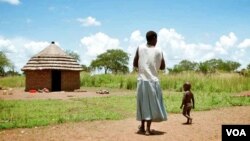
Last year there were more than 26-million people displaced within their countries by violence, conflict or natural disasters. A new report says development initiatives may help alleviate or even prevent displacement.
Of the 26-million internally displaced persons, or IDPs, about 15 million were uprooted due to natural disasters, such as floods or hurricanes. It remains unclear how many have been displaced by what’s called “slow onset disasters,” such as drought or environmental degradation.
“There is a large amount of people that we have not accounted for yet. That particularly applies obviously in Africa with drought being the major natural disaster here in Africa,’ said Nina Schrepfer is an advisor on natural disasters for the Internal Displacement Monitoring Center, which is part of the Norwegian Refugee Council. She’s in Kenya to visit the drought-stricken northeast of the country.
More than one third of the IDPs in 2011 were in Africa. The report says they outnumber refugees -- those who actually fled their home countries -- five to one.
Schrepfer said many are in a situation described as “protracted displacement.”
“Protracted displacement is a situation where IDPs cannot find a solution to their situation, either because they cannot return, and at the same time not integrate where they have displaced to – nor find a durable and a sustainable solution elsewhere in the country. So that process has, as a matter of fact, become absolutely stalled.”
“The report says internal displacement is a development challenge, as well as a humanitarian, human rights and peacebuilding challenge. Nevertheless, it says for many years the problem has been considered almost exclusively as a humanitarian issue. As a result, Schrepfer said development initiatives were often delayed. That left IDPs vulnerable once an immediate crisis, such as a food shortage or lack of shelter, had been addressed.
“The reason for that often was that the development actors were not fast enough to implement their programs when humanitarian actors were actually willing to leave. And that has led to a limbo situation where IDPs are left completely neglected at times,” she said.
The report describes displacement as a “process of impoverishment” and stresses the need for development groups to act more quickly.
“Many of the challenges that IDPs face are of a developmental nature, such as, for example, IDPs need to have access to basic services. That is not a humanitarian issue. That is a development issue. At the same time, many, many IDPs worldwide and, in particular, also here in Africa, struggle to have access to have basic services. They struggle to have access to a clinic; displaced children struggle to have access to a school,” she said.
She said if humanitarian aid continues for too long, it could result in IDPs becoming totally dependent on that assistance.
“The challenge is not the task itself. The challenge is how to collaborate better between the humanitarian and the development actors,” she said.
She described Africa as having a good framework in place to address internally displaced persons. This includes the 1981 African Charter on Human and Peoples’ Rights, that states there is a human right to development. Also, there’s the 1988 Guiding Principles on Internal Displacement, the Great Lakes Pact on Security, Stability and Development and the African Union Convention for the Protection and Assistance of Internally Displaced Persons, also known as the Kampala Convention.
“This convention,” she said, “is about to enter into force. It looks like that will happen this year. And this convention is absolutely significant. I think it is a beacon of hope for all IDPs here in Africa. This continent has actually been an absolute trailblazer compared to other continents in establishing legal frameworks.”
The convention lists the legal obligations of nations and their leaders to “respect, protect and fulfill IDPs’ economic, social, cultural, civil and political rights.” However, Schrepfer said if it’s to be taken seriously, it must be implemented by all African countries very quickly.
“To implement the Kampala Convention means that all the different actors have to work together. And that includes the humanitarian actors, that includes development actors, peacebuilding actors, human rights actors. We all need to come together to sit at the same table,” she said.
The Internal Displacement Monitoring Center report says that means coming up with a plan to meet immediate needs, as well as restoring livelihoods, food security, access to health, sanitation and education services, along with housing and land.
Of the 26-million internally displaced persons, or IDPs, about 15 million were uprooted due to natural disasters, such as floods or hurricanes. It remains unclear how many have been displaced by what’s called “slow onset disasters,” such as drought or environmental degradation.
“There is a large amount of people that we have not accounted for yet. That particularly applies obviously in Africa with drought being the major natural disaster here in Africa,’ said Nina Schrepfer is an advisor on natural disasters for the Internal Displacement Monitoring Center, which is part of the Norwegian Refugee Council. She’s in Kenya to visit the drought-stricken northeast of the country.
More than one third of the IDPs in 2011 were in Africa. The report says they outnumber refugees -- those who actually fled their home countries -- five to one.
Schrepfer said many are in a situation described as “protracted displacement.”
“Protracted displacement is a situation where IDPs cannot find a solution to their situation, either because they cannot return, and at the same time not integrate where they have displaced to – nor find a durable and a sustainable solution elsewhere in the country. So that process has, as a matter of fact, become absolutely stalled.”
“The report says internal displacement is a development challenge, as well as a humanitarian, human rights and peacebuilding challenge. Nevertheless, it says for many years the problem has been considered almost exclusively as a humanitarian issue. As a result, Schrepfer said development initiatives were often delayed. That left IDPs vulnerable once an immediate crisis, such as a food shortage or lack of shelter, had been addressed.
“The reason for that often was that the development actors were not fast enough to implement their programs when humanitarian actors were actually willing to leave. And that has led to a limbo situation where IDPs are left completely neglected at times,” she said.
The report describes displacement as a “process of impoverishment” and stresses the need for development groups to act more quickly.
“Many of the challenges that IDPs face are of a developmental nature, such as, for example, IDPs need to have access to basic services. That is not a humanitarian issue. That is a development issue. At the same time, many, many IDPs worldwide and, in particular, also here in Africa, struggle to have access to have basic services. They struggle to have access to a clinic; displaced children struggle to have access to a school,” she said.
She said if humanitarian aid continues for too long, it could result in IDPs becoming totally dependent on that assistance.
“The challenge is not the task itself. The challenge is how to collaborate better between the humanitarian and the development actors,” she said.
She described Africa as having a good framework in place to address internally displaced persons. This includes the 1981 African Charter on Human and Peoples’ Rights, that states there is a human right to development. Also, there’s the 1988 Guiding Principles on Internal Displacement, the Great Lakes Pact on Security, Stability and Development and the African Union Convention for the Protection and Assistance of Internally Displaced Persons, also known as the Kampala Convention.
“This convention,” she said, “is about to enter into force. It looks like that will happen this year. And this convention is absolutely significant. I think it is a beacon of hope for all IDPs here in Africa. This continent has actually been an absolute trailblazer compared to other continents in establishing legal frameworks.”
The convention lists the legal obligations of nations and their leaders to “respect, protect and fulfill IDPs’ economic, social, cultural, civil and political rights.” However, Schrepfer said if it’s to be taken seriously, it must be implemented by all African countries very quickly.
“To implement the Kampala Convention means that all the different actors have to work together. And that includes the humanitarian actors, that includes development actors, peacebuilding actors, human rights actors. We all need to come together to sit at the same table,” she said.
The Internal Displacement Monitoring Center report says that means coming up with a plan to meet immediate needs, as well as restoring livelihoods, food security, access to health, sanitation and education services, along with housing and land.