


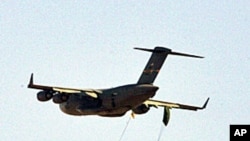
U.S. and Egyptian officials say the decision to postpone joint military exercises is due to the political transition underway in Egypt and should not be considered a sign of any rift. The postponement comes at a time of apparent Egyptian unease about the United States and its motives.
Country transition
Egypt's military rulers do have their hands full. Seven months after the revolution that ousted former President Hosni Mubarak and brought them temporarily to power, they appear to be struggling to keep the political process on track, while also fulfilling their traditional duties.
Political analyst Hisham Kassem says the two-year delay of the biennial Bright Star military exercises, the oldest in the region, makes sense. "The military now is bogged down with basically securing the country, and whether it's across the Delta, or Upper Egypt, or now with the situation in Sinai, I'm not surprised there's been a delay," Kassam stated.
But postponing the maneuvers comes amid other tensions between Washington and Cairo -- most recently, accusations that the U.S. is interfering with Egyptian politics by directly funding non-governmental groups.
"The whole way the matter was presented, like a declaration by the American ambassador that money has been given out directly, increased the sensitivity of the situation," Kassem explained.
The aid prompted criticism from Egypt's military rulers, who say such aid violates the nation's sovereignty, and they say they are launching an investigation. A state-run magazine followed up with a cover branding the new U.S. envoy Anne Patterson the "ambassador from hell."
U.S. State Department officials have called such criticism unacceptable, and defended the aid funding, saying it was not political in nature. They have also complained of what they see as anti-Americanism "creeping" into Egyptian public discourse.
Opinion polls and rumors
Recent opinion polls about Egyptian views toward the U.S. would seem to bear that out. And it is at least partially evident on the streets of Cairo.
Abdalal el-Erian works at a university in the capital. "Just recently, we have a lot of rumors and a lot of say in the street that there are funds coming to the informal sector in Egypt, civil societies, without being declared or known or anything and this is negative," he said.
For investment analyst Hana, who gave just her first name, some of the tension goes back to Washington's response during the uprising earlier this year.
"Sometimes they were very blunt in supporting the regime and sometimes they were very much opposing it and asking Mubarak to step down. It was not really very clear and definite, but they were just going with the flow I think," said Hana.
But both Hana and el-Erian point to decades of political and military cooperation between the United States and Egypt, and say they are not overly worried. The relationship has long been mutually beneficial, with the U.S. getting a strong ally in the region, and Egypt receiving more than a billion dollars in American military aid each year.
Others suggest the problems are less a reflection of tensions between Washington and Cairo, than between Egypt's military rulers and anti-government protesters. Raising the specter of a foreign, in this case American, hand in any opposition movement has a long history in Egypt.
But political analyst Kassem says the United States should be careful about creating bogeymen of its own. He objects to recent comments by U.S. legislators about the possibility of an Islamist takeover in Egypt. "As a secular person, I'd like to tell Congress, stop this scare you're creating about the Muslim Brotherhood taking over. It's very damaging for the economy," he said. "And for people like me, its unfounded on the ground."
More to the point, Kassem says, it's not any of the United States' business. The Muslim Brotherhood is Egyptian, it has the right to contest the elections and, he says, it's up to the Egyptian people to decide who they want in office.
With a series of elections in the coming months, Egyptian sensitivities on the issue are likely to increase.