


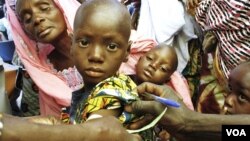
DAKAR - Officials from the European Union, the United States, Japan and other countries are meeting today to mobilize aid for some 18 million people facing severe food shortages in West Africa’s Sahel region. Families there are approaching the lean season, with the next harvest months away. But, aid experts say, it is still possible to avoid the worst.
Representatives of the affected West African countries are also taking part in Monday’s meeting in Brussels, sponsored by the European Commission.
While emergency aid is needed now, officials said it is just as important to invest to avoid future food crises.
The U.N. humanitarian office, OCHA, says there is a shortfall of about $900 million for getting urgently needed help to people in nine countries just south of the Sahara desert – Burkina Faso, Cameroon, Chad, Gambia, Mali, Mauritania, Niger, Nigeria and Senegal.
In normal times West Africa’s Sahel region gets very little rainfall, and in recent years rains have decreased even further. OCHA says that even in years when there is not an emergency, nearly a quarter of a million children die annually from malnutrition.
Many parts of the region are still reeling from severe shortages in 2010. This year, due to weak harvests, soaring food prices, erratic rains and unrest in parts of the Sahel, some 18 million people face hunger, including one million children.
Kristalina Georgieva, in charge of humanitarian aid and crisis response at the European Commission, opened the meeting in Brussels. She said these are not merely numbers.
"Behind these figures, we face real human tragedy. When I traveled to Chad and Niger in mid-January, I left from Sofia, from my hometown. One day I was playing with my 18-month old granddaughter, listening to her first words, to her crying and laughing. The next day I was in a clinic for malnourished children in Niger and I realized there, there is nothing more deafening than the silence in a room full of children."
Regional food security experts say food prices are higher than average in most markets across the Sahel. In parts of Burkina Faso and Mali, prices of the staples millet and sorghum are between 50 and 100 percent higher than the five-year average.
Steve Cockburn, regional campaigns and policy manager for Oxfam in West Africa, says: "Across a region that’s as wide as the U.S., we’re seeing 18 million people pushed to the brink, we’re seeing women who are having to search for grain in anthills, we’re seeing people having to eats roots and leaves just to survive, and that’s entirely unacceptable in any economic conditions in the 21st century."
The U.N. says both the international community and regional governments have already done a lot to save lives since seeing early signs of trouble in late 2011, but the gravity of the crisis demands more resources.
Georgieva of the European Commission said climate change is expected to put the Sahel at risk for more frequent and more severe droughts. "But," she said, "more droughts need not mean more hunger. If we all, the countries of the region and the international community, make a strong collective and coordinated push for resilience to these droughts. To prevent rather than react."
She said Monday’s meeting is aimed in part at mobilizing support for measures already underway in the region to reduce communities’ vulnerability.
Food crisis has become almost synonymous with the Sahel, and for years aid groups have talked about the need to "break the hunger cycle." Oxfam’s Cockburn says this is closer to becoming a reality because there is a growing acceptance of the mechanism to do so.
"People know there are measures we can take - we can build food reserves across the region and in communities, we can invest in social protection measures to make sure that the incomes of the most vulnerable are protected in times of crisis, and most importantly we can make sure that there’s a growing recognition that we need to invest in small-scale farmers so that they can produce more food and feed their families and their communities," he said.
Cockburn pointed out that it is far less expensive to help families produce more food and stay healthy than to treat malnourished children.
Representatives of the affected West African countries are also taking part in Monday’s meeting in Brussels, sponsored by the European Commission.
While emergency aid is needed now, officials said it is just as important to invest to avoid future food crises.
The U.N. humanitarian office, OCHA, says there is a shortfall of about $900 million for getting urgently needed help to people in nine countries just south of the Sahara desert – Burkina Faso, Cameroon, Chad, Gambia, Mali, Mauritania, Niger, Nigeria and Senegal.
In normal times West Africa’s Sahel region gets very little rainfall, and in recent years rains have decreased even further. OCHA says that even in years when there is not an emergency, nearly a quarter of a million children die annually from malnutrition.
Many parts of the region are still reeling from severe shortages in 2010. This year, due to weak harvests, soaring food prices, erratic rains and unrest in parts of the Sahel, some 18 million people face hunger, including one million children.
Kristalina Georgieva, in charge of humanitarian aid and crisis response at the European Commission, opened the meeting in Brussels. She said these are not merely numbers.
"Behind these figures, we face real human tragedy. When I traveled to Chad and Niger in mid-January, I left from Sofia, from my hometown. One day I was playing with my 18-month old granddaughter, listening to her first words, to her crying and laughing. The next day I was in a clinic for malnourished children in Niger and I realized there, there is nothing more deafening than the silence in a room full of children."
Regional food security experts say food prices are higher than average in most markets across the Sahel. In parts of Burkina Faso and Mali, prices of the staples millet and sorghum are between 50 and 100 percent higher than the five-year average.
Steve Cockburn, regional campaigns and policy manager for Oxfam in West Africa, says: "Across a region that’s as wide as the U.S., we’re seeing 18 million people pushed to the brink, we’re seeing women who are having to search for grain in anthills, we’re seeing people having to eats roots and leaves just to survive, and that’s entirely unacceptable in any economic conditions in the 21st century."
The U.N. says both the international community and regional governments have already done a lot to save lives since seeing early signs of trouble in late 2011, but the gravity of the crisis demands more resources.
Georgieva of the European Commission said climate change is expected to put the Sahel at risk for more frequent and more severe droughts. "But," she said, "more droughts need not mean more hunger. If we all, the countries of the region and the international community, make a strong collective and coordinated push for resilience to these droughts. To prevent rather than react."
She said Monday’s meeting is aimed in part at mobilizing support for measures already underway in the region to reduce communities’ vulnerability.
Food crisis has become almost synonymous with the Sahel, and for years aid groups have talked about the need to "break the hunger cycle." Oxfam’s Cockburn says this is closer to becoming a reality because there is a growing acceptance of the mechanism to do so.
"People know there are measures we can take - we can build food reserves across the region and in communities, we can invest in social protection measures to make sure that the incomes of the most vulnerable are protected in times of crisis, and most importantly we can make sure that there’s a growing recognition that we need to invest in small-scale farmers so that they can produce more food and feed their families and their communities," he said.
Cockburn pointed out that it is far less expensive to help families produce more food and stay healthy than to treat malnourished children.