



News / Africa

DRC Election Commission Expects Presidential Results This Week

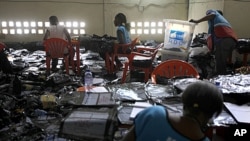
Election volunteers tabulate results at the Fikin compilation center in Kinshasa, Democratic Republic of Congo. Congo's influential clergy say they are concerned about violence and unrest two days before the proclamation of results from a contested presid
TEXT SIZE - +

In the Democratic Republic of Congo, there are increasing concerns about violence in the lead-up to the release of the results of last week's presidential election.

The country's election commission says it will announce the winner of the poll Tuesday. Preliminary results showed the incumbent, Joseph Kabila, gaining more than 50 percent of the vote.  His closest rival, veteran opposition leader Etienne Tshisekedi, got about 34 percent.

On Sunday, Congo's bishops held a rare news conference to appeal for calm.  The head of the influential Christian conference, Nicolas Djomo, warned that Congo is, in his words, like a "high-speed train heading directly into a wall."  He called on the country's leaders to "put on the brakes."

Both the Kabila and Tshisekedi camps say they are confident of victory and are warning of a renewed outbreak of violence if the vote does not go the way they are predicting.

Last week's balloting was only the second free election since the African nation was torn apart by several years of warfare that ended in 2003.

Already, Human Rights Watch has reported the killings of at least 18 civilians and the wounding of 100 others in election-related attacks.

The voting over three days was described as chaotic, marred by what the U.N. Security Council called "logistical and technical difficulties."

International observers describe ballots being burned and dumped into mud, especially at voting centers in Kinshasa, the capital, where Tshisekedi has strong support.

Some information for this report was provided by AP, AFP and Reuters.

You May Like

President Karzai to Discuss Enhancing Defense Ties with India

Afghanistan looking for more military aid as it prepares for withdrawal of NATO forces by next year More

India, China Pledge to Overcome Border Tensions

Indian prime minister and Chinese premier attempt to move past tense standoff in the Himalayas during Delhi talks More

Burmese President Opens US Visit with VOA Town Hall Meeting

Ahead of his meeting with President Obama Monday, Thein Sein answered questions on human rights and economic development in his country More

This forum has been closed.
Comments
     
There are no comments in this forum. Be first and add one

Featured Videos

Your JavaScript is turned off or you have an old version of Adobe's Flash Player. Get the latest Flash player.
Video

Video Boston Bomber Spent 6 Months in Russia’s Most Violent Republic

The news of the Boston Marathon bombings circled the globe, and resonated here in Dagestan, a majority Muslim republic in Russia, on the shores of the Caspian Sea. Last year, Tamerlan Tsarnaev, the older of two brothers suspected of the bombings and a long-time Boston resident, returned to Dagestan, where he had lived for a year during his youth. Dagestan was the land of his maternal ancestors. But in the last two years, this republic of 3 million people has gained notoriety as the region with the highest level of political and religious violence in all of Russia. VOA's James Brooke reports from Makhachkala, Russia.