


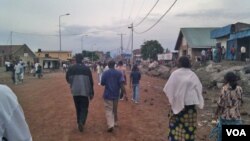
Humanitarian agencies are still trying to reach thousands of people in the eastern DRC who were displaced by the recent military offensive by M23 rebels. Many of the displaced fear they may have to flee violence yet again.
The situation in Goma, capital of North Kivu Province, is described as calm during the day, but marked by nighttime banditry. Goma is a hub of humanitarian activity. The Congolese army retook control after M23 rebels withdrew last week.
“We are obviously still looking at a really acute humanitarian situation here. We have about 130,000 people living in camps in and around Goma and those are just the camps here. We also know in Masisi territory to the west of Goma there’s a lot of fighting there between several different armed groups. We can’t access that area very easily at the moment; and we’re really concerned about the situation there as well,” said Oxfam spokesperson Christina Corbett, who is in Goma.
Oxfam is working in three of the main camps around Goma. Two are overcrowded. The camps are filled with those who’ve been displaced numerous times over the past month. That’s in addition to many displacements over recent years. A new camp is currently under construction to help alleviate the overcrowding.
“We are scaling-up our response so that we can reach about 100,000. We truck a lot of water into these camps. The main focus of our work is water and sanitation, and we bring a lot of clean water into the camps. But the infrastructure that was already set up in some of these camps is not able to cope with the number of people that are now living in some of these camps,” she said.
If water is not trucked into the camps, Corbett said the displaced are forced to get water from Lake Kivu or use dirty water to wash or drink.
She said, “There’s still enormous uncertainty here, and people don’t really know what is going to happen. This constant displacement does take a huge toll on the population, and it takes people away from their lands. They’re not farming so they can’t grow the food that they need.”
Corbett said Goma continues to have periodic power outages, which affects pumping clean water into the city. She added if the situation remains calm, the infrastructure should become more reliable.
Oxfam and other aid agencies said the response to the situation in eastern Congo remains underfunded. They also call on all armed groups in the region to allow them access to those in need.
The situation in Goma, capital of North Kivu Province, is described as calm during the day, but marked by nighttime banditry. Goma is a hub of humanitarian activity. The Congolese army retook control after M23 rebels withdrew last week.
“We are obviously still looking at a really acute humanitarian situation here. We have about 130,000 people living in camps in and around Goma and those are just the camps here. We also know in Masisi territory to the west of Goma there’s a lot of fighting there between several different armed groups. We can’t access that area very easily at the moment; and we’re really concerned about the situation there as well,” said Oxfam spokesperson Christina Corbett, who is in Goma.
Oxfam is working in three of the main camps around Goma. Two are overcrowded. The camps are filled with those who’ve been displaced numerous times over the past month. That’s in addition to many displacements over recent years. A new camp is currently under construction to help alleviate the overcrowding.
“We are scaling-up our response so that we can reach about 100,000. We truck a lot of water into these camps. The main focus of our work is water and sanitation, and we bring a lot of clean water into the camps. But the infrastructure that was already set up in some of these camps is not able to cope with the number of people that are now living in some of these camps,” she said.
If water is not trucked into the camps, Corbett said the displaced are forced to get water from Lake Kivu or use dirty water to wash or drink.
She said, “There’s still enormous uncertainty here, and people don’t really know what is going to happen. This constant displacement does take a huge toll on the population, and it takes people away from their lands. They’re not farming so they can’t grow the food that they need.”
Corbett said Goma continues to have periodic power outages, which affects pumping clean water into the city. She added if the situation remains calm, the infrastructure should become more reliable.
Oxfam and other aid agencies said the response to the situation in eastern Congo remains underfunded. They also call on all armed groups in the region to allow them access to those in need.