


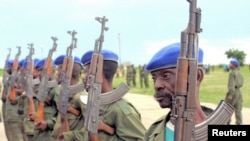
Increased fighting between Democratic Republic of Congo forces and Mai-Mai militias in the last couple of months has forced hundreds more residents in Katanga province to flee their homes into the bush. Fighting in the area has continued to increase since April 2012, displacing the majority of the people.
The medical aid group Doctors Without Borders, also known by its French acronym, MSF, said people in Shamwana are terrified and the group’s outreach activities to the surrounding areas have been hampered by the violence.
“Well, the fact is if they cannot reach an M-S-F facility, a Doctors Without Borders facility, then they will not have any possibility to get healthcare, unless they turn to traditional healers,” explained Jan-Peter Stellema, MSF’S Operations Manager for the DRC, who added “and we know that at this moment a number of our clinics have been looted. And we also know that in Shamwana, where we run our hospital, the population has almost fully fled to the surrounding jungle.”
Stellema emphasized that the health situation of the displaced has become dire. Those patients that do reach the hospital despite a perilous journey are shown to have late stage ailments.
At the moment, the region is in its peak season of malaria, which runs from January through April. Stellema said during this time there are normally one to three thousand patients per week coming in to be treated for malaria, now, that is not the case.
He explained, “We see very limited numbers now simply because the clinics are not functional or because the population cannot reach us.
Another big medical concern is complicated deliveries of babies. Stellema gave an example of a woman who had been in labor for five days. The baby would not deliver, so the mother turned to a traditional healer to help with the labor. Stellema said by the time the mother reached the hospital it was too late. “In the end she took all kinds of drinks that, together with the long journey when she finally made it to the hospital, caused the death of the baby. The mother luckily survived,” said Stellema.
Stellema pointed out that this example is one of the many extreme conditions in which people live in the bush. He said people are afraid. They are hiding, and are afraid of being mistaken by combatants by either of the opposing and parties. He said people are looking for safety far from the villages that they once called home.
The medical aid group Doctors Without Borders, also known by its French acronym, MSF, said people in Shamwana are terrified and the group’s outreach activities to the surrounding areas have been hampered by the violence.
“Well, the fact is if they cannot reach an M-S-F facility, a Doctors Without Borders facility, then they will not have any possibility to get healthcare, unless they turn to traditional healers,” explained Jan-Peter Stellema, MSF’S Operations Manager for the DRC, who added “and we know that at this moment a number of our clinics have been looted. And we also know that in Shamwana, where we run our hospital, the population has almost fully fled to the surrounding jungle.”
Stellema emphasized that the health situation of the displaced has become dire. Those patients that do reach the hospital despite a perilous journey are shown to have late stage ailments.
At the moment, the region is in its peak season of malaria, which runs from January through April. Stellema said during this time there are normally one to three thousand patients per week coming in to be treated for malaria, now, that is not the case.
He explained, “We see very limited numbers now simply because the clinics are not functional or because the population cannot reach us.
Another big medical concern is complicated deliveries of babies. Stellema gave an example of a woman who had been in labor for five days. The baby would not deliver, so the mother turned to a traditional healer to help with the labor. Stellema said by the time the mother reached the hospital it was too late. “In the end she took all kinds of drinks that, together with the long journey when she finally made it to the hospital, caused the death of the baby. The mother luckily survived,” said Stellema.
Stellema pointed out that this example is one of the many extreme conditions in which people live in the bush. He said people are afraid. They are hiding, and are afraid of being mistaken by combatants by either of the opposing and parties. He said people are looking for safety far from the villages that they once called home.