


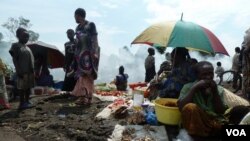
The medical aid group, Medecins Sans Frontieres (MSF), also known as Doctors Without Borders, said the medical consequences resulting from the displacement of civilians from fighting between the Democratic Republic of Congo government forces and Mai-Mai militias in Katanga province are severe.
The group said it is concerned that many patients will be prevented from accessing healthcare in an already precarious health situation. Thousands have been displaced and have fled into the bush fearing for their lives, as tensions continue to increase between the clashing parties.
Christine Slagt, MSF’s project coordinator in Shamwana, said many patients are unable to return to health facilities to continue essential medical treatment.
“You must imagine the area from where we are working. This is north of Katanga. It’s very isolated, very few health services.. it’s very difficult to reach people because [they] are constantly on the move fleeing violence,” she said.
Slagt said a big part of the population of those fleeing villages along the 70km stretch between Shamwana and Mpiana are believed to be in the bush, which makes access to them very difficult. In addition, the region is experiencing an increase in malaria.
“It’s malaria season, and we see a lot of [it]. If people don’t get to us in time, this might have very severe consequences. Other threats are malnutrition, respiratory infections, HIV and TB patients who cannot come back for treatments,” explained Slagt.
She added that MSF is also concerned about victims of violence. They are being treated and Slagt said as the violence continues in the region, more are likely to need treatment.
Slagt said the MSF is running one hospital in Shamwana and is supporting six health clinics. She emphasized that what needs to be done at this time is that the clashing parties must respect the population so that they feel safe enough to come out of the bush and seek the medical care they need.
The group said it is concerned that many patients will be prevented from accessing healthcare in an already precarious health situation. Thousands have been displaced and have fled into the bush fearing for their lives, as tensions continue to increase between the clashing parties.
Christine Slagt, MSF’s project coordinator in Shamwana, said many patients are unable to return to health facilities to continue essential medical treatment.
“You must imagine the area from where we are working. This is north of Katanga. It’s very isolated, very few health services.. it’s very difficult to reach people because [they] are constantly on the move fleeing violence,” she said.
Slagt said a big part of the population of those fleeing villages along the 70km stretch between Shamwana and Mpiana are believed to be in the bush, which makes access to them very difficult. In addition, the region is experiencing an increase in malaria.
“It’s malaria season, and we see a lot of [it]. If people don’t get to us in time, this might have very severe consequences. Other threats are malnutrition, respiratory infections, HIV and TB patients who cannot come back for treatments,” explained Slagt.
She added that MSF is also concerned about victims of violence. They are being treated and Slagt said as the violence continues in the region, more are likely to need treatment.
Slagt said the MSF is running one hospital in Shamwana and is supporting six health clinics. She emphasized that what needs to be done at this time is that the clashing parties must respect the population so that they feel safe enough to come out of the bush and seek the medical care they need.