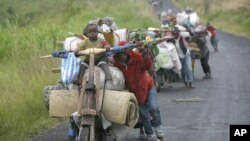
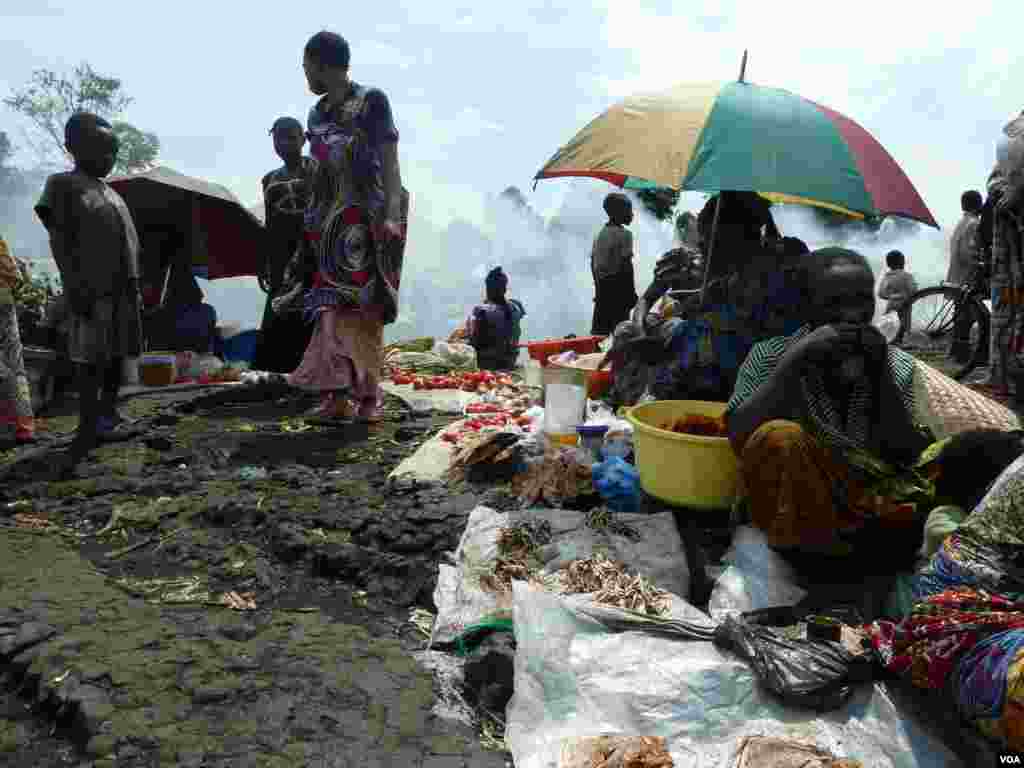
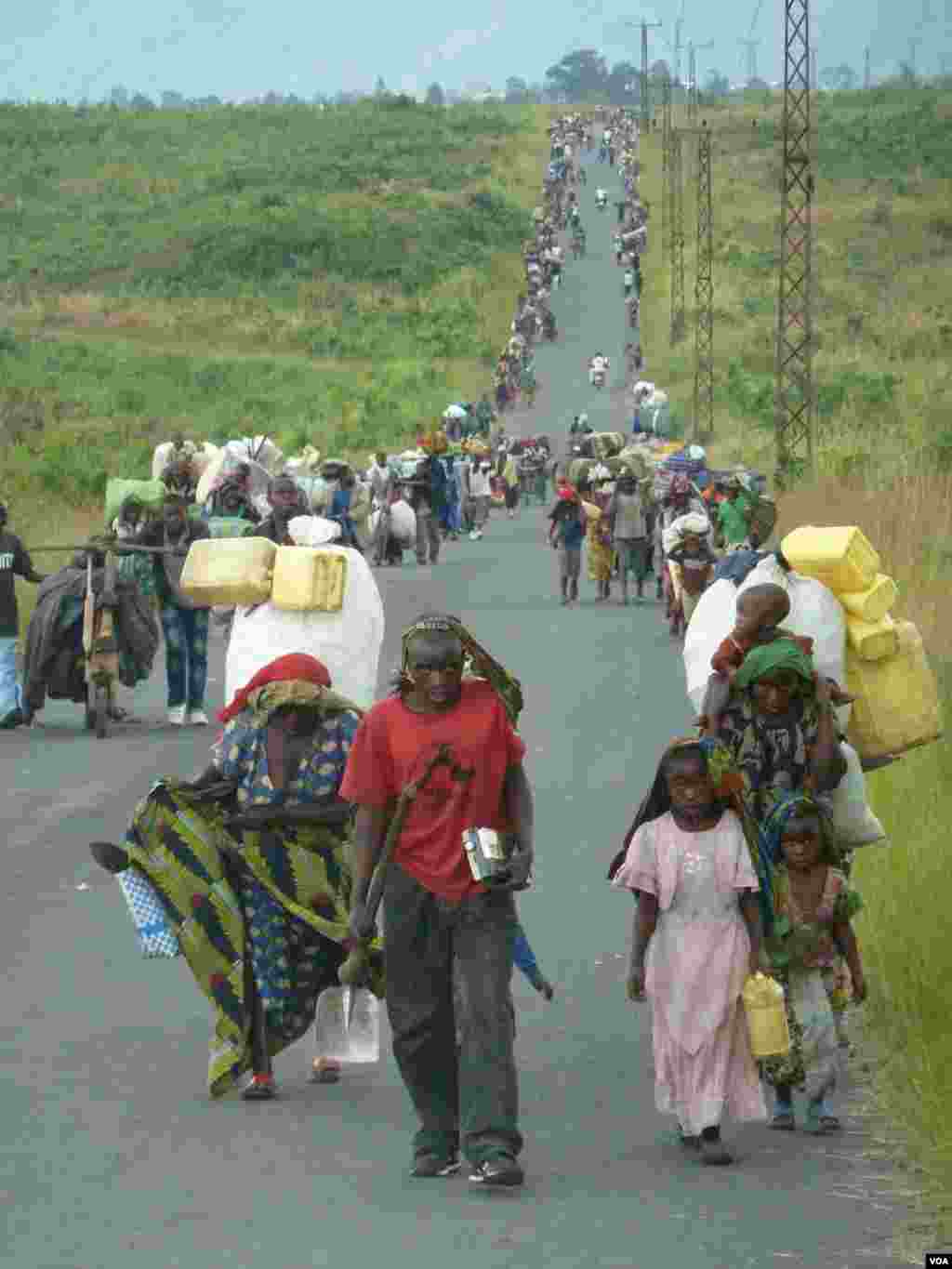
Congolese flee the eastern Congolese town of Sake, 27km west of Goma, Friday November 23, 2012.
As fighting continues in the eastern DRC between government forces and M23 rebels, the humanitarian crisis is growing worse. Oxfam says it’s stepping up efforts to help about 80,000 people in and around Goma, the capital of North Kivu Province.
M23 rebels took over Goma last week, disrupting humanitarian operations not only in the provincial capital, but in surrounding camps for the displaced.
Oxfam’s Christina Corbett is in Goma, where thousands of people have sought shelter in schools, churches and elsewhere. She said, “People are trying to carry on with a normal life. They’re trying to go about their daily business. Most of the shops are open. Banks are still closed, but certainly the smaller shops are all open and people are carrying on as usual, but there is certainly a feeling that they don’t know what’s going to happen next.”
There are electricity and water shortages in Goma.
“Goma is very poorly resourced to deal with the high concentrated numbers of IDPs that have come here and in the surrounding areas as well. Obviously, without enough clean water, sanitation becomes an issue, and disease outbreaks are a huge concern for us,” she said.
Oxfam specializes in providing clean water and sanitation.
It’s providing assistance at camps for IDPs, or internally displaced persons, including the Lac Vert Camp on the edge of Goma, and the Mugunga 1 camp. Construction of water systems is also expected to begin soon at a new camp at Bulengo.
Corbett said, “We’re working in two of the largest IDP camps to the west of Goma. In one of them we’re trucking in fresh water, because at the moment there is no water infrastructure there. In the other camp we were previously working there. We already had in place a water infrastructure system, which we’re now rapidly having to expand. We also are building latrines in those camps and we’re building latrines in another site in town.”
About 40 latrines have been constructed at the Don Bosco Catholic center in Goma.
“There are about 8,000 people there. They have absolutely nothing. Inside the compound, there are several buildings and people have hung plastic sheets from the sides of the buildings. And they’re just living around the edges of the buildings,” said Corbett.
Many are making their beds on Goma’s hard volcanic rock terrain.
Corbett said what’s happening in Goma is part of the bigger conflict in North Kivu Province, which is home to many armed groups. They’ve attacked and looted villages and killed and raped civilians – women, children and men.
“There is fighting in other parts of North Kivu. We know there’s fighting in Masisi. We know people are being displaced there because of the insecurity. We don’t have access, and that’s also a huge concern for us, because all eyes are on Goma at the moment. It was such a strategic prize and it’s a very important place; and it marks the latest development in the conflict. But there’s also a lot happening in other places,” she said.
The Oxfam spokesperson added that many of the displaced have lost all sense of home. She says they’re ready to move at a moment’s notice to find a new safe place.
Families flee fighting in DRC
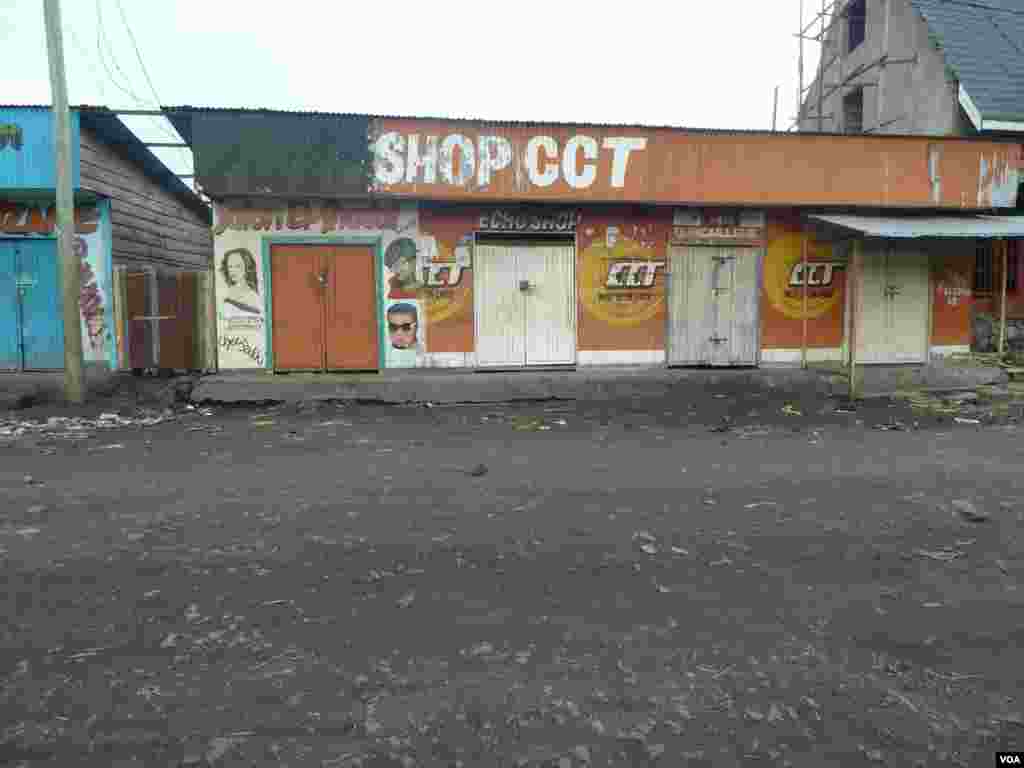
1/5Shops closed in Sake a day after M23 rebels took control of the town following overnight battles with the Congolese army, DRC, November 23, 2012. (G. Joselow/VOA)
Families flee fighting between the Congolese army and M23 rebels in the town of Sake, DRC
Show moreShow less
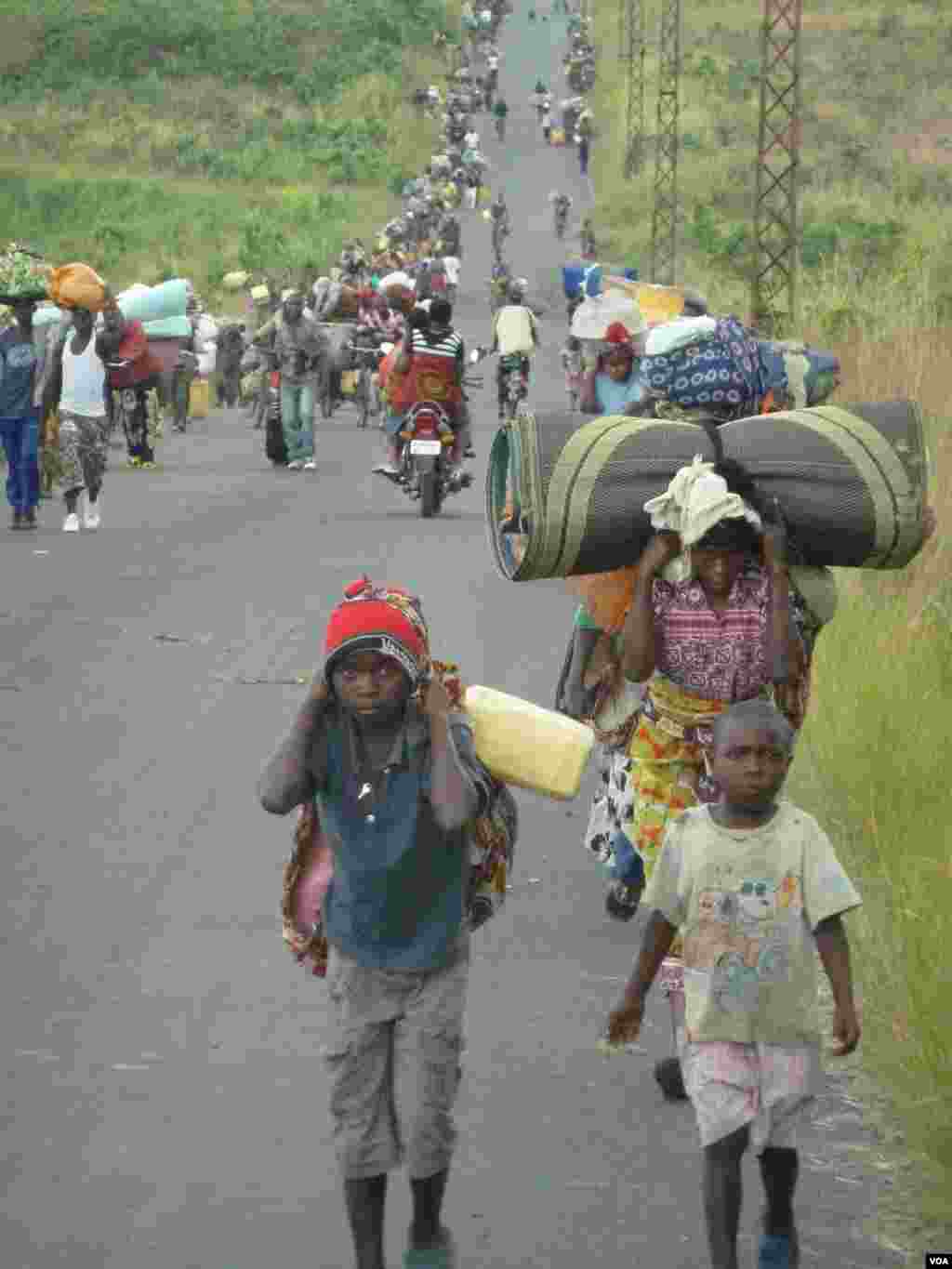
2/5Fighting has displaced tens of thousands of people from the town of Sake, west of Goma, DRC, November 23, 2011. (G. Joselow/VOA)
Families flee fighting between the Congolese army and M23 rebels in the town of Sake, DRC
Show moreShow less
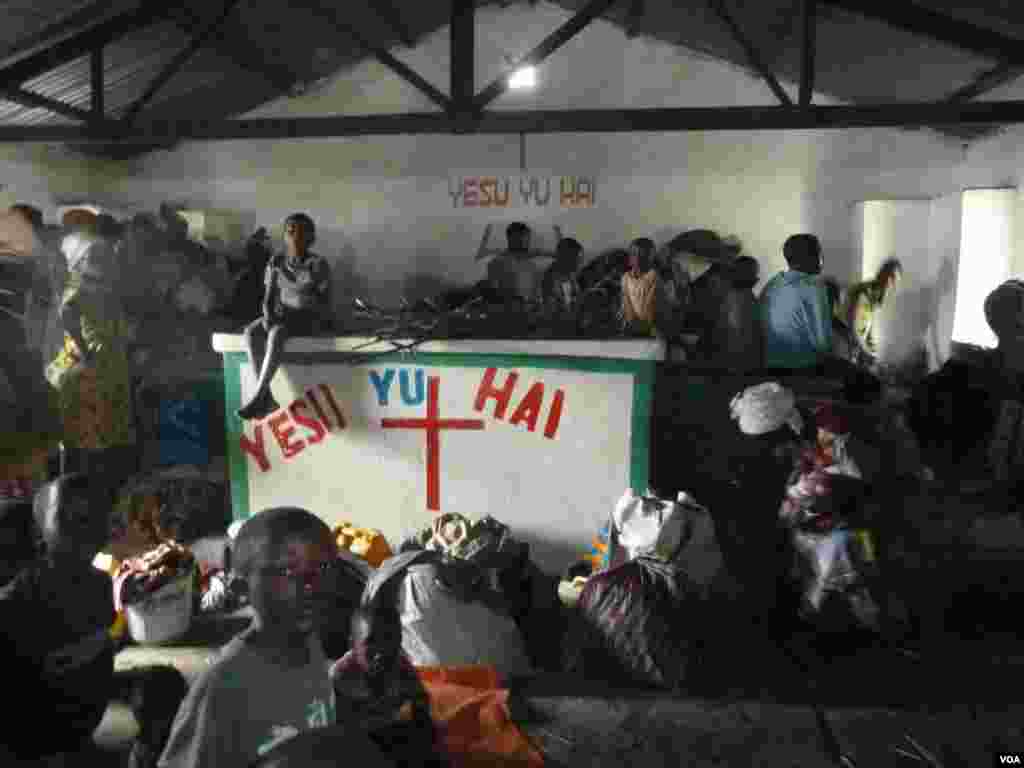
3/5With IDP camps filling up since the rebellion in eastern Congo began in April, newly displaced people are sleeping in churches until they can find a place to settle, DRC, November 23, 2012. (G. Joselow/VOA)
Families flee fighting between the Congolese army and M23 rebels in the town of Sake, DRC
Show moreShow less
4/5Displaced people from the town of Sake gather at the Mugunga camp on the road to Goma, DRC, November 23, 2012. (G. Joselow.VOA)
Families flee fighting between the Congolese army and M23 rebels in the town of Sake, DRC
Show moreShow less
5/5Families flee fighting between the Congolese army and M23 rebels in the town of Sake, DRC, November 23, 2012. G. Joselow/VOA)
Families flee fighting between the Congolese army and M23 rebels in the town of Sake, DRC