Presidential and legislative elections in the Democratic Republic of Congo are being extended into Tuesday in areas where people were unable to vote because of violence or because ballots were delivered late.
Where voting ended more or less on schedule, electoral officials emptied ballot boxes and started the vote count.
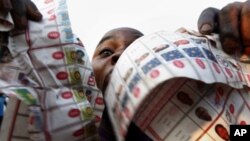
At one polling station in Kinshasa's Gombe neighborhood, legislative ballots the size of small newspapers were stacked on the floor as party monitors counted along with poll workers under the light of a small, battery-powered lantern.
But some polling stations ran out of ballots. Others failed to open because no electoral materials were delivered. In those cases, Congo's electoral commission says voting will continue on Tuesday.
Electoral commission spokesman Matthieu Mpita says people at polling places that ran out of ballots should remain calm and await further instructions. He says voters at polling stations where ballots never arrived should wait for those materials to be delivered.
Many of the polling places that failed to open were in the southern city of Lubumbashi, where gunmen attacked a convoy of vehicles carrying ballots and a polling station in the Bel-Air neighborhood. The Associated Press reports that Interior Minister Bikanga Kazadi said soldiers put down the attacks in a firefight that left four assailants and one policeman dead.
Monday's attacks follow the killing of at least three people on Saturday, when riot police fired bullets and tear gas at supporters of the leading opposition candidate, Etienne Tshisekedi.
Mr. Tshisekedi proclaimed himself president ahead of the election and said his supporters will “take their responsibilities,” if they do not believe the vote is fair.
Another opposition candidate, Vital Kamerhe, says there has been electoral fraud, with ballots that have been marked for President Joseph Kabila in advance.
Electoral commission president Daniel Ngoy-Mulunda says there is no merit to the accusations. He calls this second multi-party vote since the country's independence from Belgium in 1960 "credible" and "transparent."
Final results are expected before President Kabila's current mandate expires on December 6.
DRC Voting Extended to Tuesday After Violence, Late Delivery of Ballots