


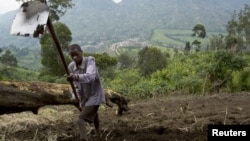
GOMA -- The Democratic Republic of Congo’s government has promised to abolish fertilizer taxes, which are among the highest in the region. Farmer’s groups have welcomed the pledge, saying that fertilizer helps to reduce poverty and resolve conflicts, and even improve domestic relations.
But regional fertilizer use is a controversial subject among some development experts. One agricultural project manager working for the Belgian government said that, in parts of the Congo where land is abundant, it makes more sense for farmers to cultivate virgin soil than to buy expensive supplements.
But he also admitted that had never been to the Kivu region.
High on a hillside in North Kivu, a chorus of farmers and tree planters in blue overalls and yellow safety helmets greet visitors from a fertilizer project supported by the International Fertilizer Development Center (IFDC), a U.S.-based non-profit organization.
"We’re still young, we can keep up this kind of work all day," the chorus sings, extolling the virtues of tree-planting as a means to prevent erosion and provide charcoal and fertilizer in the form of leaves which are ploughed deep into the soil.
Down in the valley a smaller group promoting chemical fertilizer -- which was hardly used in the region until recently -- has assembled.
Female farmer Vea Khavumo tells onlookers she has shown eight of her neighbors how to use chemical fertilizer. One after another, members of the group explain that the correct mixture of chemical and organic fertilizer, along with improved seeds, can triple or quadruple yields of maize, rice, beans and potatoes.
Although the fertilizer costs around $1.30 a kilo, a tripled yield of crops, say IFDC workers, can mean a substantial increase in profits.
One farmer, Adrien Kangele, says the new methods promoted by IFDC could even help to resolve ethnic conflicts across the Kivu region.
"Fertilizer brings peace, because it enables more people to make a living from the soil in this densely-populated area," he says.
Sandra Kavira Kawisse, a trainer and agronomist in South Kivu, says fertilizer can even save people’s marriages. Just north of Goma, she says, many men had left their wives to seek work in the mines, leaving the women to farm by themselves. Many started using fertilizer and saw their rice yields triple.
"When the husbands noticed this, they said ‘oh, the women have become rich -- we left them and they have become rich,'" she says, adding that, since then, husbands are no longer ashamed to be seen working alongside their wives in the fields.
IFDC has also found that when the men work with women, rice yields further increase from an average of six tons per hectare to nine.
According to Dutch scientist Henk Breman, who designed the fertilizer project, DRC uses less chemical fertilizer per hectare than any other country in the world, averaging about 0.8 kilos per hectare per year, compared with the world average of about 110 kilos per hectare per year. In his view, Congolese fertilizer use is low for two reasons: lack of government policy and the influence of donors and international NGOs.
"There has been a period of about 20 years when donor support was dominated by policies that looked for other ways of developing agriculture than the intensive way elsewhere," he says. "I really accuse the donors and the international NGOs for part of the famine in Africa."
Edwige Mungwana Kavor, a local agronomist who works for U.S.-based Mercy Corps, warns of risks attached to chemical fertilizer, although she doesn't oppose its use as a supplement to organic matter.
There is a danger, she says, that land can become dependent on chemicals, such that it cannot produce without them, and that chemicals can leach into groundwater and cause toxic pollution.
While Breman agrees chemical fertilizers aren't completely free from risk, the right approach, he says, is to mix them with organic fertilizers.
"The risk of not using fertilizer is a thousand times bigger than the risk of using fertilizer," he says, explaining that, especially in a place like Kivu, such contingencies must be considered in context. "Go to a region like the Bukavu zone, you see whole mountains going into the lake -- erosion is unbelievably high by over-exploitation of land. The soil nutrient balance of this region is the most negative in the world."
For a province once known as the breadbasket of the Congo, though, it would seem that spreading the message of informed fertilization is worth the effort.
But regional fertilizer use is a controversial subject among some development experts. One agricultural project manager working for the Belgian government said that, in parts of the Congo where land is abundant, it makes more sense for farmers to cultivate virgin soil than to buy expensive supplements.
But he also admitted that had never been to the Kivu region.
High on a hillside in North Kivu, a chorus of farmers and tree planters in blue overalls and yellow safety helmets greet visitors from a fertilizer project supported by the International Fertilizer Development Center (IFDC), a U.S.-based non-profit organization.
"We’re still young, we can keep up this kind of work all day," the chorus sings, extolling the virtues of tree-planting as a means to prevent erosion and provide charcoal and fertilizer in the form of leaves which are ploughed deep into the soil.
Down in the valley a smaller group promoting chemical fertilizer -- which was hardly used in the region until recently -- has assembled.
Female farmer Vea Khavumo tells onlookers she has shown eight of her neighbors how to use chemical fertilizer. One after another, members of the group explain that the correct mixture of chemical and organic fertilizer, along with improved seeds, can triple or quadruple yields of maize, rice, beans and potatoes.
Although the fertilizer costs around $1.30 a kilo, a tripled yield of crops, say IFDC workers, can mean a substantial increase in profits.
One farmer, Adrien Kangele, says the new methods promoted by IFDC could even help to resolve ethnic conflicts across the Kivu region.
"Fertilizer brings peace, because it enables more people to make a living from the soil in this densely-populated area," he says.
Sandra Kavira Kawisse, a trainer and agronomist in South Kivu, says fertilizer can even save people’s marriages. Just north of Goma, she says, many men had left their wives to seek work in the mines, leaving the women to farm by themselves. Many started using fertilizer and saw their rice yields triple.
"When the husbands noticed this, they said ‘oh, the women have become rich -- we left them and they have become rich,'" she says, adding that, since then, husbands are no longer ashamed to be seen working alongside their wives in the fields.
IFDC has also found that when the men work with women, rice yields further increase from an average of six tons per hectare to nine.
According to Dutch scientist Henk Breman, who designed the fertilizer project, DRC uses less chemical fertilizer per hectare than any other country in the world, averaging about 0.8 kilos per hectare per year, compared with the world average of about 110 kilos per hectare per year. In his view, Congolese fertilizer use is low for two reasons: lack of government policy and the influence of donors and international NGOs.
"There has been a period of about 20 years when donor support was dominated by policies that looked for other ways of developing agriculture than the intensive way elsewhere," he says. "I really accuse the donors and the international NGOs for part of the famine in Africa."
Edwige Mungwana Kavor, a local agronomist who works for U.S.-based Mercy Corps, warns of risks attached to chemical fertilizer, although she doesn't oppose its use as a supplement to organic matter.
There is a danger, she says, that land can become dependent on chemicals, such that it cannot produce without them, and that chemicals can leach into groundwater and cause toxic pollution.
While Breman agrees chemical fertilizers aren't completely free from risk, the right approach, he says, is to mix them with organic fertilizers.
"The risk of not using fertilizer is a thousand times bigger than the risk of using fertilizer," he says, explaining that, especially in a place like Kivu, such contingencies must be considered in context. "Go to a region like the Bukavu zone, you see whole mountains going into the lake -- erosion is unbelievably high by over-exploitation of land. The soil nutrient balance of this region is the most negative in the world."
For a province once known as the breadbasket of the Congo, though, it would seem that spreading the message of informed fertilization is worth the effort.