



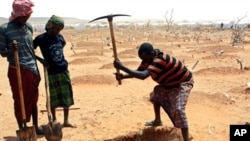
A senior official of the International Federation of Red Cross and Red Crescent Societies warns many people in drought-stricken Ethiopia are at risk of dying if urgent action is not taken to assist them. The official, who has just returned from Ethiopia, says millions of drought affected people are being overlooked because of the focus on famine-stricken Somali refugees who have fled to Ethiopia in search of food.
Millions affected by the drought
The United Nations estimates more than 12 million people in the Horn of Africa are affected by drought. More than one-third of them are in Ethiopia. And, yet a senior official of the International Red Cross Federation says not enough attention is being paid to their plight.
Red Cross Operations Coordinator Christine South says the international community is focusing most strongly on the Somali refugees. She says this is quite understandable as Somalia is in the grips of a famine and its people are in desperate need of food and other assistance.
“But, at the same time, the host or indigenous communities are, particularly in some of these dry areas in the southeast, are pretty well on the edge…If you are in a camp, there is a structure in place to provide support," South states. "I think these families live in very remote rural communities. Some of them are nomadic, so they are on the move. They are much harder to reach and to identify, and to assess. So, they are harder to work with in a sense. But, that does not mean that their needs are not grave and that they do not need to be met.”
Running out of options
Ethiopia has been without significant rain for three seasons in a row and, South says, the people are pessimistic that the next rains due in October will be good. This, she says, means people not only have to be able to survive the present crisis, they also must plan ahead for the coming months.
Unfortunately, she says, people are running out of options. “So, many of their options are just closed down to them. And, I think it is that lack of anywhere else to go, which means that their need for support is urgent," South said. "And, we want to do it before we start seeing human deaths rather than wait until we have a more dire situation before reacting.”
The International Red Cross Federation estimates about two million of the 4.5 million drought-affected Ethiopians are in need of food. The agency has launched a $10 million preliminary appeal to assist 165,000 people. It only has received 29 percent of that amount.
Nevertheless, given the needs, the Red Cross says it plans to scale up its operations and will issue a revised appeal to meet the increased needs of a larger number of drought victims.
Priority - getting food to people
Christine South says getting food to hungry people is the priority. This, she says, can be done by food distributions or, in many cases, by providing cash vouchers so people can buy food in the markets.
Other priorities include water and sanitation and health care. Once the immediate survival needs are met, she says the Red Cross will focus on longer-term solutions. For example, it will help people improve their agriculture and sustain their flock through better water management and irrigation.