



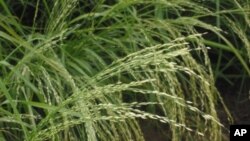
Growing awareness of a digestive disorder triggered by a protein found in wheat and other grains is creating a market in the United States for non-traditional grains— including teff, a staple of the Horn of Africa.
Bread can be a hazardous substance for a little under one percent of the world's population. These people have a genetic disorder called celiac disease, in which gluten— a protein found in wheat, barley and rye— triggers a reaction that causes their immune systems to attack the small intestine. It can result in malnutrition and other problems.
'Who's allergic to bread?'
Anna Quigg was diagnosed with the disorder about seven years ago. As a teenager, she suffered from stomach problems and occasional constipation.
Sometimes she would have the opposite problem. "I couldn't eat anything and not have to rush to the bathroom," she says.
She also suffered from joint pain and anemia. She didn't know what caused her symptoms and never suspected wheat was the problem.
"Who thinks they're allergic to bread?" Quigg says.
Celiac disease is actually more than an allergy. It's an autoimmune disease. The body's defenses mistakenly attack the lining of the small intestine, where nutrients are absorbed, which leads to malnutrition.
Symptoms and severity vary. Quigg's stomach problems, joint pains and anemia are common. Serious cases cause stunted growth in children, and can lead to liver disease, seizures and miscarriages in adults.
Not a rare disorder
According to Alessio Fasano, director of the Celiac Research Center at the University of Maryland, celiac disease used to be considered a rare disorder, found mostly among Europeans.
"Now, with large epidemiological studies done everywhere including here, we can say with a great level of confidence that the disease affects roughly the same percentage of the general population worldwide. That is, roughly one percent," says Fasano. "So, it's not rare at all."
And if it's not rare, that means there are a lot of potential customers looking for gluten-free products. Food manufacturers have caught on. Quigg says it was a lot harder to find gluten-free foods when she was first diagnosed seven years ago.
"I do remember the first time I went grocery shopping it took me about three hours, and I kind-of wanted to cry when I came home because it was just overwhelming."
Gluten-free fad
Today, she can find products without gluten almost anywhere. The gluten-free market is now worth more than a billion-and-a-half dollars a year.
That's partly because of the growing awareness about celiac disease. But it's also partly because gluten-free has become a new fad diet. Some people without celiac disease say they feel better when they avoid gluten, but many scientists are skeptical.
Whatever the reason, the demand for gluten-free products creates an opportunity for farmers like David Eckert. About eight years ago, he says, he saw a strange sight on a farm near his home in Nevada.
"I just [saw] a crop growing that I'd never seen before," he says, "And I looked at it for a long time. Finally, I [saw] somebody up there in that field one day, and I normally don't do that, but my curiosity got the best of me."
Eckert went up to the farmer and asked what he was growing. It was teff, a staple grain of the Horn of Africa. It does not contain gluten. A couple years went by before Eckert decided to try growing teff himself, replacing some of his alfalfa and maize.
Profitable crop
"What comes along to most of us is the almighty dollar," he says. "That's what kind-of impressed me about it was it looked to me like I could do better with this than I could with [maize]."
Eckert says the teff business has been strong. Nevada now grows about half of the teff produced in the United States, worth about a million dollars to the state's farmers.— not a huge segment of the market, but Eckert expects it will grow.
"The non-gluten market, I think is going to be a big market. I think it's just getting there and knowing the right people, getting into the larger companies that are going to really use the product."
Nutritious and delicious?
Companies making gluten-free products use teff partly because it is more nutritious than some of their other main ingredients such as rice flour and potato starch. But teff also has some competition in that role from other grains such as buckwheat, quinoa and amaranth.
Celiac disease patient Quigg sometimes buys bread made with teff and other whole grains. She gives it a tepid endorsement.
"It's O.K.," she says. "It's not as soft. But I think that's expected with a whole-grain bread. But, you know, it's fine."
That could be an obstacle for teff: most Americans— even those with celiac disease— like their bread white and soft.