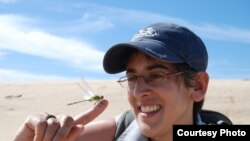
University of British Columbia ecologist Diane Srivastava, with a damselfly, an insect often used as an indicator species for estimating biodiversity and assessing ecosystem health. (T. Zulkoskey)
In advance of the United Nations Conference on Sustainable Development in Rio de Janiero later this month, ecologists writing in the journal Nature are calling for renewed international efforts to curb the loss of biodiversity.
The paper summarizes more than 1,000 ecological studies conducted since the first Earth Summit in Rio 20 years ago.
Biodiversity loss impacts human health
Lead author and University of Michigan ecologist Bradley Cardinale says the 17 co-authors speak with a single voice: the loss of plant and animal diversity reduces the productivity and sustainability of earth’s ecosystems.
“And in many instances it decreases their ability to provide services like food. It decreases the ability of ecosystems to produce wood, fodder that would be used to feed our livestock. It reduces the ability of the ecosystems to protect us and our crops from certain kinds of pests and disease. And, it decreases the ability of nature to regulate certain aspects of our global climate.”
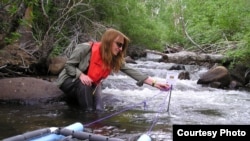
A researcher measures the productivity of algae in a stream. (Brad Cardinale)
On the other hand, Cardinale says, the evidence shows that genetic diversity increases the yield of commercial crops and enhances the production of wood in tree plantations.
Forests with more tree species are more effective at absorbing carbon dioxide, a climate changing greenhouse gas. And, crops enhanced by genetic variation are better able to resist disease or attack by exotic species.
“We also know that the yield of fish out of our oceans tends to be more sustainable and stable through time, in fisheries that have a wide variety of fish species compared to parts of the ocean that don’t.”
Delicate balance
A bio-diverse ecosystem is often a delicate balance, and it doesn’t take much to upset it. In her research, co-author Diane Srivastava has studied the cascading effects of extinction. In one experiment, the University of British Columbia ecologist removed the ecosystem’s top predator - a damsel fly larva - from a single bromeliad plant - with surprising results.
“We saw effects, of course, on the insects that that damsel fly larva consumed, which we expected," she says, "but what we didn’t expect is to see effects on the very tiny microscopic organisms that were consuming the dead leaves in the system, you know, a completely different part of the food web.”
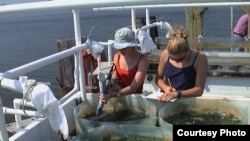
Students measure ecosystem production in an estuary. (Emmett Duffy)
Cardinale says it is getting more difficult to sustain biodiversity, as more and more species go extinct. “But the real concern is that rates of extinction are about 1,000 times faster than what occurs naturally in the fossil record, and that rate of extinction is going up and the projection is if that rate continues we will be reaching the same level of the big five (earth) mass extinctions within about 250 to 400 years.”
The good news, Cardinale notes, is that we are not there yet. There is still time to slow the loss of biodiversity and protect the troves of animal and plant life that offer humans so much - from new ways of understanding the world and our place in it, to miraculous new medicines and industrial materials. “If you essentially want to tell people how much species extinction is going to affect you - it’s going to affect your health or your pocketbook -we need to put a per dollar or per disease value on each species that goes extinct. And so the very obvious next step is translating these goods and services into economic value.”
Cardinale says that assessment is realistically about five years away.
The report in the journal Nature directs a public warning to the international forum meeting in Rio that the loss of biodiversity is having a direct impact on human health and prosperity.