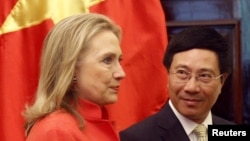
U.S. Secretary of State Hillary Clinton is expected to focus more on economic than military concerns as she tours Southeast Asia this week.
Clinton, who arrived in Vietnam Tuesday, is scheduled to announce a series of proposals aimed at expanding U.S. investment and exports in a region that boasts some of the world's fastest growing economies.
But increased U.S. economic activity in Southeast Asia is likely to be viewed as a challenge by China, which has already voiced opposition to the Obama administration's new strategic focus on the Pacific.
Since Washington's "pivot" toward Asia was announced last year, the U.S. has renewed military ties with several countries - including the Philippines and Vietnam - which share U.S. concerns over China's rising economic power and military assertiveness.
Analysts expect Clinton to downplay U.S.-China friction when she attends a meeting of regional foreign ministers in Cambodia on Wednesday, saying she will emphasize Washington's desire for cooperation with Beijing.
Carl Thayer, a Southeast Asia securities expert at the University of New South Wales, tells VOA that Clinton will stress that the Obama administration is not only focused on the region for military purposes.
"The rebalancing we're going to hear is economic engagement with the region and America's interest in education, health promotion, environmental and water management along the Mekong [River], that there are a whole raft of other issues that the U.S. is going to be engaged with to rebalance, so that the view that the U.S. is only interested in military confrontation with China is a second component of the rebalancing," said Thayer.
Later this week, Clinton will host a large gathering of U.S. business executives in Cambodia to discuss ways of increasing U.S. exports to the region. She is also expected to roll out what officials describe as "very substantial new resources" for nations along the Mekong River.
But even as Clinton focuses on furthering economic ties, differences with China seem certain to surface. In Mongolia Monday, Clinton linked economic growth to democracy, in what was seen by many as a veiled criticism of China.
"We need to make the 21st century a time in which people across Asia don't only become more wealthy," she said. "They must also become more free."
She said in the Mongolian capital of Ulaanbaatar that support for democracy and human rights is the "heart" of the United States' strategy in Asia.
For its part, China lashed out Tuesday against the increased U.S. presence in the region. An article in the Communist Party-controlled Global Times insisted that the goal of Washington's pivot toward Asia is to contain China - an allegation the U.S. has repeatedly denied.
Clinton, who arrived in Vietnam Tuesday, is scheduled to announce a series of proposals aimed at expanding U.S. investment and exports in a region that boasts some of the world's fastest growing economies.
But increased U.S. economic activity in Southeast Asia is likely to be viewed as a challenge by China, which has already voiced opposition to the Obama administration's new strategic focus on the Pacific.
Since Washington's "pivot" toward Asia was announced last year, the U.S. has renewed military ties with several countries - including the Philippines and Vietnam - which share U.S. concerns over China's rising economic power and military assertiveness.
Analysts expect Clinton to downplay U.S.-China friction when she attends a meeting of regional foreign ministers in Cambodia on Wednesday, saying she will emphasize Washington's desire for cooperation with Beijing.
Carl Thayer, a Southeast Asia securities expert at the University of New South Wales, tells VOA that Clinton will stress that the Obama administration is not only focused on the region for military purposes.
"The rebalancing we're going to hear is economic engagement with the region and America's interest in education, health promotion, environmental and water management along the Mekong [River], that there are a whole raft of other issues that the U.S. is going to be engaged with to rebalance, so that the view that the U.S. is only interested in military confrontation with China is a second component of the rebalancing," said Thayer.
Later this week, Clinton will host a large gathering of U.S. business executives in Cambodia to discuss ways of increasing U.S. exports to the region. She is also expected to roll out what officials describe as "very substantial new resources" for nations along the Mekong River.
But even as Clinton focuses on furthering economic ties, differences with China seem certain to surface. In Mongolia Monday, Clinton linked economic growth to democracy, in what was seen by many as a veiled criticism of China.
"We need to make the 21st century a time in which people across Asia don't only become more wealthy," she said. "They must also become more free."
She said in the Mongolian capital of Ulaanbaatar that support for democracy and human rights is the "heart" of the United States' strategy in Asia.
For its part, China lashed out Tuesday against the increased U.S. presence in the region. An article in the Communist Party-controlled Global Times insisted that the goal of Washington's pivot toward Asia is to contain China - an allegation the U.S. has repeatedly denied.
Some information for this report was provided by AFP and Reuters.