



News / Economy

Economists: US Must Do More To Cut Deficit & Debt
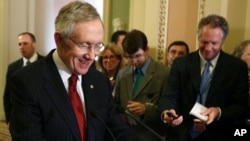
Senate Majority Leader Harry Reid (D-NV) speaks to the media after a closed door meeting with Senate Democrats and Vice President Joseph Biden, at the U.S. Capitol, on August 1, 2011 in Washington, DC.
TEXT SIZE - +

Economists say the new agreement to cut some U.S. spending and allow the government to borrow more money is just the first of many steps needed to solve the debt and deficit issue.

The agreement cuts around $1 trillion in spending over the next ten years and mandates a complex process intended to bring another $1.5 trillion in deficit reductions.

The head of the world's largest bond mutual fund says the agreement does not put a "significant dent" in U.S. spending next year.  Writing on the PIMCO company website, Bill Gross says it will take trillions of dollars in further deficit reduction for the United States to keep its top-level credit rating.  He says the government could depreciate the currency or use inflation to ease the burden of repaying the huge debt.

China's government, which holds trillions of dollars in U.S. debt, says the agreement is "good news" for the U.S. and global economies, but makes only a "small dent" in the nation's huge debt.  The commentary appeared on the government-controlled People's Daily website.  It urges Washington to "live within its means."  It says sharp budget cuts could hurt economic growth and raise unemployment in the short term, but are necessary for the health of the economy.  

An article in The Boston Globe, says national government spending cuts could raise unemployment and hurt the economy in Massachusetts, which has many military, medical, and educational institutions funded by Washington.

But other experts say the impact will not be felt for some time because the cuts over the next two years amount to tens of billions of dollars, a small percentage of federal government spending.  Deeper cuts are set for later years.

Some information for this report provided by AFP.

You May Like

Karzai to Discuss Enhancing Defense Ties with India

Afghanistan looking for more military aid as it prepares for withdrawal of NATO forces by next year More

India, China Pledge to Overcome Border Tensions

Indian prime minister and Chinese premier attempt to move past tense standoff in the Himalayas during Delhi talks More

Burmese President Opens US Visit with VOA Town Hall Meeting

Ahead of his meeting with President Obama Monday, Thein Sein answered questions on human rights and economic development in his country More

This forum has been closed.
Comments
     
There are no comments in this forum. Be first and add one

Featured Videos

Your JavaScript is turned off or you have an old version of Adobe's Flash Player. Get the latest Flash player.
Video

Video US Oil Surge Could Impact Mideast Geopolitics

The United States will account for a third of new oil supplies over the next five years, and will become energy self-sufficient in 20 years, according to a new report by the Paris-based International Energy Agency (IEA). Although U.S. oil imports from Arab Gulf countries increased last year, analysts predict the U.S. will lose its dependence on Middle East imports, which is expected to have a huge impact on international relations and the balance of power. VOA's Henry Ridgewell reports.

World Currencies

EUR
USD
0.7661
JPY
USD
99.249
GBP
USD
0.6510
CAD
USD
1.0118
INR
USD
54.524

Rates may not be current.