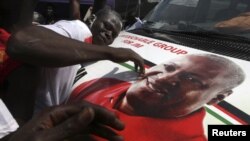
National Democratic Congress (NDC) party supporters celebrate the victory of their candidate, John Dramani Mahama, in Accra, December 9, 2012.
The president of the ECOWAS commission says he is pleased with the organization and conduct of voters during Ghana’s elections.
Ambassador Kadre Desire Ouedraogo commended the Independent Electoral Commission (INEC), the political parties and the people of Ghana for what he says was a peaceful vote.
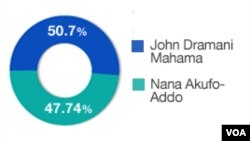
Ghana election results, December 10, 2012
His comments came after the Independent Electoral Commission (INEC) confirmed incumbent President John Mahama has been elected to his first full term in office. He was closely followed by main opposition challenger Nana Addo Dankwa Akufo-Addo.
The opposition New Patriotic Party claimed the vote was marred by fraud.
But Ouedraogo said, “Overall, everything went relatively well. And I must commend [the] Ghanaian people, the political parties and also all the voters for their sense of discipline and also the peaceful nature of this election.”
“I have observed that there was a strong enthusiasm from all parties around this election and from the polling stations we visited, we were encouraging for democracy in Ghana,” continued Ouedraogo.
Ouedraogo, who was a leading member of the ECOWAS poll observer group that monitored the election, said the electoral body swiftly resolved concerns of late voting and breakdowns of the new biometric verification machines. The breakdown of the machines subsequently led to delays and an extension of voting to Saturday.
“They had given instructions that the batteries of all these identification machines should be changed very five hours, but unfortunately, this instruction was not followed by everyone,” continued Ouedraogo, “I think that it was lack of communication. They should sensitize more the presiding officers of the polling stations, and we could have avoided these incidents.”
Ghanaian President Wins New Term
1/7Supporters of President John Dramani Mahama celebrate in the streets after he was declared the winner of Ghana's presidential election, Accra, Ghana, December 9, 2012.
Ghana's president, John Dramani Mahama, has won a new term in a vote praised by the head of the Economic Community of West African States as "encouraging" for the country.
Show moreShow less
2/7Supporters of President John Dramani Mahama celebrate in the streets after he was declared the winner of Ghana's presidential election, Accra, Ghana, December 9, 2012.
Ghana's president, John Dramani Mahama, has won a new term in a vote praised by the head of the Economic Community of West African States as "encouraging" for the country.
Show moreShow less
3/7A woman casts her vote for the presidential election at a polling station in Accra, Ghana, December 7, 2012.
Ghana's president, John Dramani Mahama, has won a new term in a vote praised by the head of the Economic Community of West African States as "encouraging" for the country.
Show moreShow less
4/7A man registers to vote at a polling station in Kibi, eastern Ghana, December 7, 2012.
Ghana's president, John Dramani Mahama, has won a new term in a vote praised by the head of the Economic Community of West African States as "encouraging" for the country.
Show moreShow less
5/7People wait to vote at a polling station in Kibi, eastern Ghana, December 7, 2012.
Ghana's president, John Dramani Mahama, has won a new term in a vote praised by the head of the Economic Community of West African States as "encouraging" for the country.
Show moreShow less
6/7Ghanaian presidential candidate Nana Akufo-Addo (L) of the opposition New Patriotic Party (NPP) waves during his last rally at Sutherland Addy Children's Park in Accra, Ghana, December 5, 2012.
Ghana's president, John Dramani Mahama, has won a new term in a vote praised by the head of the Economic Community of West African States as "encouraging" for the country.
Show moreShow less
7/7John Dramani Mahama (R), Ghana's interim president and National Democratic Congress (NDC) presidential candidate, waves during his last electoral rally, Accra, Ghana, December 5, 2012.
Ghana's president, John Dramani Mahama, has won a new term in a vote praised by the head of the Economic Community of West African States as "encouraging" for the country.
Show moreShow less
Previous slide
Next slide
Ouedraogo called on the electoral commission to take proactive measures to address the breakdown of the machines for future elections.
“The recommendation we are making is that maybe in the future, use the voters’ list for identification. As long as you have a photograph of the voter and you have all his particulars, I believe that this can be a safe way for identification,” said Ouedraogo.
The political parties, Ouedraogo said, unanimously agreed to the strict use of the biometric verification machines.
“The fact that they said that no identification by machine, no vote, is a collective decision by all parties so that we respect this decision and we believe also that there is a more viable way to identify voters, but sometimes you cannot trust [machines] so you have to live with it. But I think this is a lesson learn[ed] for future elections,” said Ouedraogo.
He said Ghana’s election should be an example to countries in the West African region.