



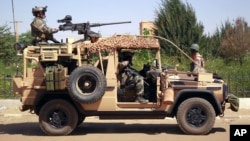
An official of the Economic Community of West African States (ECOWAS) says the first phase of the intervention in Mali is about to end following the success of the military offensive against Islamist militants in the West African nation.
ECOWAS political director Abdel-Fatau Musah says regional forces are being deployed to the liberated regions in northern Mali as part of an effort to secure the cities and reassure the residents.
“Arrangements are being made to move troops to secure the cities. There are forces from Niger and Chad who are in Gao. Forces from Burkina Faso are around Mopti and the Nigerian forces as also deploying to secure liberated zones. This is just the first phase of the operation,” said Musah.
His comments came after interim President Dioncounda Traore ruled out negotiations with the insurgents.
Musah says the Islamists mounted little resistance in the face of French and Malian troops and fled to their hideouts in the desert and the mountains.
“We anticipate a second phase of the war, which is going to be a sort of a guerrilla hit and run tactic,” said Musah. “AFISMA [African-led International Support Mission to Mali] is already preparing a contingency plan for that to occupy and secure the liberated zones. And to also take active measures to make sure that those forces that are on the run are neutralized, so that they don’t constitute a permanent threat in the desert.”
He says he is satisfied with the military intervention in Mali as ECOWAS readies plans for the next phase, which he says is to make sure the country can secure its territorial integrity.
Musah admits there were logistical challenges AFISMA faced during the deployment of troops to Mali.
“There are partners who are ready to assist, including the U.K., Canada, Sweden and others to airlift troops to the theater of operations. The U.N. is also working towards the logistics package to support it,” said Musah.
The United Nations has already established two funds - one for Mali and the other for AFISMA to help provide support for the military action in Mali.
So far, international donors at the African Union summit in Ethiopia pledged about $455 million to support efforts in Mali.
Meanwhile, the European Union plans to host a summit on the situation in Brussels, Belgium. ECOWAS, the African Union, the United Nations, Mali’s neighboring countries and other international partners are expected to be at the conference.
“That is going to discuss both the progress on the military front and progress as far as the institutional crisis is concerned. We are talking about internal dialogue and the roadmap, which has been proposed by the interim President Dioncounda Traore, which has been put before parliament now. That must lead to free and fair elections hopefully the end of July this year,” said Musah.
ECOWAS political director Abdel-Fatau Musah says regional forces are being deployed to the liberated regions in northern Mali as part of an effort to secure the cities and reassure the residents.
“Arrangements are being made to move troops to secure the cities. There are forces from Niger and Chad who are in Gao. Forces from Burkina Faso are around Mopti and the Nigerian forces as also deploying to secure liberated zones. This is just the first phase of the operation,” said Musah.
His comments came after interim President Dioncounda Traore ruled out negotiations with the insurgents.
Musah says the Islamists mounted little resistance in the face of French and Malian troops and fled to their hideouts in the desert and the mountains.
“We anticipate a second phase of the war, which is going to be a sort of a guerrilla hit and run tactic,” said Musah. “AFISMA [African-led International Support Mission to Mali] is already preparing a contingency plan for that to occupy and secure the liberated zones. And to also take active measures to make sure that those forces that are on the run are neutralized, so that they don’t constitute a permanent threat in the desert.”
He says he is satisfied with the military intervention in Mali as ECOWAS readies plans for the next phase, which he says is to make sure the country can secure its territorial integrity.
Musah admits there were logistical challenges AFISMA faced during the deployment of troops to Mali.
“There are partners who are ready to assist, including the U.K., Canada, Sweden and others to airlift troops to the theater of operations. The U.N. is also working towards the logistics package to support it,” said Musah.
The United Nations has already established two funds - one for Mali and the other for AFISMA to help provide support for the military action in Mali.
So far, international donors at the African Union summit in Ethiopia pledged about $455 million to support efforts in Mali.
Meanwhile, the European Union plans to host a summit on the situation in Brussels, Belgium. ECOWAS, the African Union, the United Nations, Mali’s neighboring countries and other international partners are expected to be at the conference.
“That is going to discuss both the progress on the military front and progress as far as the institutional crisis is concerned. We are talking about internal dialogue and the roadmap, which has been proposed by the interim President Dioncounda Traore, which has been put before parliament now. That must lead to free and fair elections hopefully the end of July this year,” said Musah.
