



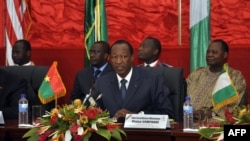
Officials from the Economic Community of West African States (ECOWAS) plan to meet representatives of the United Nations Friday to review plans to deploy troops to Mali, where Islamist militants control the north. The meeting is to be held in Mali’s capital, Bamako.
“It’s a follow up meeting which is being coordinated by the African Union,” said Sonny Ugoh, ECOWAS communications director. “It’s a mechanism that enables ECOWAS, the African Union and the U.N. to review developments in Mali to see how we can respond to the security challenges within the context of the impending deployment of the peacekeeping force.”
West African regional leaders mandated that ECOWAS deploy troops to help Mali’s military defeat the Islamists, who are suspected of having links with al-Qaida.
The regional bloc teamed up with Mali’s transitional government to ask the U.N. Security Council in September to authorize a military intervention to oust the Islamists, who control about two-thirds of Mali's national territory.
Along with Tuareg separatists, the Islamists seized control of the north in April, a month after the coup in Bamako. Since then, the militant groups Ansar Dine and Movement for Oneness and Jihad in West Africa have moved to enforce a strict version of Islamic law.
Humanitarian groups say more than 1.5 million Malians left their homes because of the fighting, with about 40,000 of those displaced going to the regional city of Mopti. Over 200,000 refugees have registered in both Mauritania, and Burkina Faso, 30,000 in Algeria and 40,000 in Niger.
Last week the U.N. Security Council approved an ECOWAS military plan to help the Malian army retake the country’s north from the Islamists.
“This meeting is to enable us to make use of the expertise of both the U.N. and the AU in order for us to see how to best meet the requirement to deploy the troops,” Ugoh said.
He said ECOWAS is continuing its preparations until the deploy order is given.
“We are working on the possible deployment of 3,300 troops there and it is within that context that we are going to have this meeting to review the latest development,” said Ugoh.
The Security Council gave ECOWAS 45 days to present a specific plan for the military intervention.
“The meeting [will] try and develop a roadmap that would enable us to respond to the requirement of the U.N. Security Council as per the Security Council resolution 2071 so that we can address the challenges that the U.N. Security Council has put on our plate to be able to satisfy the Council,” Ugoh said.
“It’s a follow up meeting which is being coordinated by the African Union,” said Sonny Ugoh, ECOWAS communications director. “It’s a mechanism that enables ECOWAS, the African Union and the U.N. to review developments in Mali to see how we can respond to the security challenges within the context of the impending deployment of the peacekeeping force.”
West African regional leaders mandated that ECOWAS deploy troops to help Mali’s military defeat the Islamists, who are suspected of having links with al-Qaida.
The regional bloc teamed up with Mali’s transitional government to ask the U.N. Security Council in September to authorize a military intervention to oust the Islamists, who control about two-thirds of Mali's national territory.
Along with Tuareg separatists, the Islamists seized control of the north in April, a month after the coup in Bamako. Since then, the militant groups Ansar Dine and Movement for Oneness and Jihad in West Africa have moved to enforce a strict version of Islamic law.
Humanitarian groups say more than 1.5 million Malians left their homes because of the fighting, with about 40,000 of those displaced going to the regional city of Mopti. Over 200,000 refugees have registered in both Mauritania, and Burkina Faso, 30,000 in Algeria and 40,000 in Niger.
Last week the U.N. Security Council approved an ECOWAS military plan to help the Malian army retake the country’s north from the Islamists.
“This meeting is to enable us to make use of the expertise of both the U.N. and the AU in order for us to see how to best meet the requirement to deploy the troops,” Ugoh said.
He said ECOWAS is continuing its preparations until the deploy order is given.
“We are working on the possible deployment of 3,300 troops there and it is within that context that we are going to have this meeting to review the latest development,” said Ugoh.
The Security Council gave ECOWAS 45 days to present a specific plan for the military intervention.
“The meeting [will] try and develop a roadmap that would enable us to respond to the requirement of the U.N. Security Council as per the Security Council resolution 2071 so that we can address the challenges that the U.N. Security Council has put on our plate to be able to satisfy the Council,” Ugoh said.
