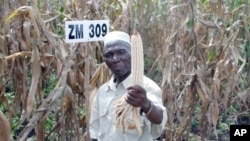
Research into improving global maize supplies got a $170 million dollar boost today.
The new initiative, led the Mexico-based International Maize and Wheat Improvement Center, aims to raise productivity enough to feed 130 million more people by 2020.
Officials at the center, which is known by its Spanish acronym, CIMMYT, say the project will focus on helping small-holder farmers in developing countries. However, the research will benefit everyone.
Maize is a staple food for nearly a billion people worldwide today.
Demand is expected to double by 2050 as world population tops nine billion and the need for livestock feed also increases.
Challenges
At the same time, maize farmers are facing a number of serious challenges.
"We have climate change," says CIMMYT chief Thomas Lumpkin. "We have energy prices. We have water depletion. We have rapidly rising fertilizer prices that are pushing down our ability to produce food."
The maize research initiative includes developing new tools so farmers can make more efficient use of fertilizer. It will also help adapt the grain itself to the higher temperatures and more frequent droughts and floods expected with climate change while fortifying it against increased pressures from weeds, pests and diseases.
Massive maize collection
CIMMYT holds a collection of some 27,000 varieties of maize at its headquarters in Mexico, where the crop was first domesticated. The initiative aims to identify valuable genetic traits buried in the DNA sequence of all those varieties. Mexico is a major donor to that effort.
"Mexico is very proud that they have given maize to the world," Lumpkin says. "Now, Mexico wants to give the world the DNA sequence of maize."
Iowa State University maize researcher Roger Elmore, who is not involved in the project, praises its comprehensive approach and the impressive level of funding. "One hundred and seventy million dollars would go a long way toward improving things here and probably a lot further in the developing world."
Small investments, big gains
Often, it doesn't take much money to improve yields. Elmore worked in Haiti a few years ago, where he helped farmers increase their yields from two tons per hectare to five tons.
"With just some fertilizer, more plants per area, and just better management," he says. "Two to five tons. It's just information and a little bit of technology. That's all it took."
The CIMMYT initiative aims to benefit 40 million small-holder farm families in the developing world by 2020.
But the benefits of research will be felt around the world, according to Lloyd Le Page, head of CIMMYT's parent organization, the Consultative Group on International Agricultural Research.
"Let's face it, food is a global issue," he says, "whether we're talking about Iowa farmers or whether we're talking about farmers in Africa."
Research into improving yields under hotter temperatures will help maize farmers almost everywhere. And as climate changes, pests and diseases expand into new territories, including parts of the semi-tropical developed world, farmers in wealthy countries will find research into warding them off to be very useful.