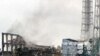




Japanese firefighters halted water spraying on Monday at the country's severely crippled nuclear power plant after smoke was spotted rising from one of the reactor buildings.
It is the latest setback in Japan's effort to cool crippled reactors and their exposed used radioactive fuel at the Fukushima-1 complex in the northeastern part of the country. The power plant's cooling system was knocked out on March 11th by a huge tsunami triggered by a magnitude 9.0 earthquake.
The Fukushima-1 nuclear power plant was temporarily evacuated Monday after smoke was seen rising from the Number-3 reactor building. Japanese crews have been taking turns in the dousing operation to avoid excessive exposure to the high radiation levels since last Thursday.
The deputy director of Japan's Nuclear and Industrial Safety Agency, Hidehiko Nishiyama, says there was no explosion before the sighting of the smoke, which is not believed to be linked to the reactor's overheating fuel rods.
Radiation levels are stable, says Nishiyama, and officials are trying to determine the source of the smoke from the reactor whose mixed oxide fuel contains highly toxic plutonium.
On Sunday, officials said pressure in the Number-3 reactor's containment vessel temporarily rose, but later stabilized.
There were also reports of white smoke seen above the Number-2 reactor unit late Monday. Tokyo Electric Power Company says it appears that steam was released, but the source was not the pool for used fuel rods.
Before the latest setback, Japanese officials said it would like take several more days to restore power to the Number-2 reactor where the core containment vessel may have been damaged. It is one of three reactors at the Fukushima-1 nuclear power plant with cores that, officials say, may have partially melted. Seawater has been pumped into them to prevent the fuel from being exposed.
Tokyo Electric says external power lines have been re-connected to the crippled facility. That will allow plant operators to again properly monitor radiation levels, illuminate control rooms and stabilize the cooling process.
Another serious challenge faces the crews working to stabilize the Number-4 reactor. Its fuel was not in the reactor core at the time of the March 11th earthquake. Those fresher fuel rods - hotter in terms of radiation - are exposed because the roof of the reactor building was blown off in an explosion.
Speaking Monday in Vienna to the board of governors of the International Atomic Energy Agency, director-general Yukiya Amano said the crisis at the Fukushima-1 plant has not been resolved and the situation "remains very serious."
The Japanese government ordered four prefectures to halt shipments of two vegetables, because the levels of radiation found in the produce exceeded legal limits. Fukushima prefecture has also been told not to ship raw milk.
In Ibaraki prefecture, spinach 27 times over the limit for radioactive iodine and quadruple the allowed maximum for cesium has been detected.
Ibaraki governor Masaru Hashimoto is seeking to reassure understandably jittery consumers, now worried about whether it is safe to eat vegetables.
The governor says even if a person were to eat the spinach they would not suffer any ill effect. Trace amounts of radioactive substances have also been detected since Sunday in the tap water of nine prefectures.