


CAIRO - After the promise of round one of Egypt's first post-revolution presidential election, a bitter debate has arisen among many voters over the relative merits - and demerits - of the final two candidates.
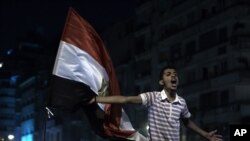
The crowds on Tahrir Square last year were euphoric; they had forced their president of nearly 30 years to resign. The promise of the revolution was still there in round one -- 13 candidates on the ballot, the first real choice most voters had ever had.
But the fruits of that effort - a run-off between Islamist Mohamed Morsi and a candidate of the old guard, Ahmed Shafiq - have proved bitter to many.
The majority of Egyptians voted for neither. Going into round two, many face a depressing decision of which candidate they dislike the least.
Political sociologist Said Sadek is no fan of the old government - he calls it “military fascism.” But, he says, one alternative is worse.
“Politics is about relative points of views," said Sadek. "When you use religion, you're talking about the absolute: this is their opinion and that's it."
Sadek points to experiments with religious rule elsewhere.
“Are we going to repeat the Iranian revolution and what the Iranian secularists and liberals did? -- that out of their hatred to the Shah they collaborated with a worse political group that in the end slaughtered them," said Sadek.
For decades the Muslim Brotherhood has publicly renounced violence. But even among Egyptians who find the group less distasteful than the military, its current promise of moderation is less than convincing.
A columnist and advocate of the revolution, Rania el Malki, says the Muslim Brotherhood "would say something today and change their mind about it tomorrow. And this is what they have done even, you know, when it came to fielding their president in the first place."
Despite her reservations, el Malki says at least there is hope the Brotherhood's stated commitment to civil liberties is better than the known repression of the old guard.
“We are caught between the devil and the deep blue sea [two bad choices], the devil or drowning]] and I think, in the deep blue sea scenario some miracle could happen," said el Malki. "I’d rather take that chance than know we are going back to exactly where we were on 24th of January 2011.”
Adding to the sense of gloom, is the possibility of the worst of both.
“What I fear most is an alliance between military fascism and religious fascism and this has started from the beginning of the revolution,” said Said Sadek.
While such pessimism is not shared by all, it is the sentiment of many, not just in Egypt, but across the region - where the hopes of the Arab Spring are tempered by political realities.
The crowds on Tahrir Square last year were euphoric; they had forced their president of nearly 30 years to resign. The promise of the revolution was still there in round one -- 13 candidates on the ballot, the first real choice most voters had ever had.
But the fruits of that effort - a run-off between Islamist Mohamed Morsi and a candidate of the old guard, Ahmed Shafiq - have proved bitter to many.
The majority of Egyptians voted for neither. Going into round two, many face a depressing decision of which candidate they dislike the least.
Political sociologist Said Sadek is no fan of the old government - he calls it “military fascism.” But, he says, one alternative is worse.
“Politics is about relative points of views," said Sadek. "When you use religion, you're talking about the absolute: this is their opinion and that's it."
Sadek points to experiments with religious rule elsewhere.
“Are we going to repeat the Iranian revolution and what the Iranian secularists and liberals did? -- that out of their hatred to the Shah they collaborated with a worse political group that in the end slaughtered them," said Sadek.
For decades the Muslim Brotherhood has publicly renounced violence. But even among Egyptians who find the group less distasteful than the military, its current promise of moderation is less than convincing.
A columnist and advocate of the revolution, Rania el Malki, says the Muslim Brotherhood "would say something today and change their mind about it tomorrow. And this is what they have done even, you know, when it came to fielding their president in the first place."
Despite her reservations, el Malki says at least there is hope the Brotherhood's stated commitment to civil liberties is better than the known repression of the old guard.
“We are caught between the devil and the deep blue sea [two bad choices], the devil or drowning]] and I think, in the deep blue sea scenario some miracle could happen," said el Malki. "I’d rather take that chance than know we are going back to exactly where we were on 24th of January 2011.”
Adding to the sense of gloom, is the possibility of the worst of both.
“What I fear most is an alliance between military fascism and religious fascism and this has started from the beginning of the revolution,” said Said Sadek.
While such pessimism is not shared by all, it is the sentiment of many, not just in Egypt, but across the region - where the hopes of the Arab Spring are tempered by political realities.