


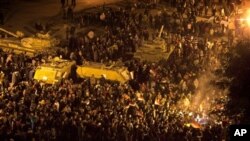
Egypt's President Hosni Mubarak said in a national address on Thursday that he will not step down until a new president is selected in elections scheduled for September. Many demonstrators were disappointed by Mr. Mubarak's speech.
This certainly wasn’t the speech people were expecting or hoping to hear. They had earlier in the day been so excited and the mood had been very anticipatory and people were talking about who might be able to take over. So when they hear the name, the news that nothing really has changed, there wasn’t great outrage, but just further disappointment.
Many people here say they are just going to continue to come out. They are worried that the speech was aimed at dividing people and turning some people against the protesters, which may or may not have been part of the aim of the speech. He came out very strongly, Mr. Mubarak, who explained how strong he has been for the country. But it wasn’t anywhere near the delegation of power he gave earlier and it fell far short of protestors' demands. They promise to come back out and continue to protest for their demands until they are met.
It’s a very confusing situation and that was the statement that got everybody so excited and thought that this would be it. I think people are worried because Friday, the demonstrations might be even larger, especially now that you have people from factories, from unions -- all joining, some of them for economic demands, not just more people on the street. And the feeling was that the Army was going to stand in and try to calm things down. People continue to have a fairly strong sympathy for the Army. It’s a neutral force. People I were speaking to earlier -- they said they would be happy if the military took over, just not in a political sense, but as a guarantee of some kind of continuity as they go forward in trying to form a transitional government.
There’s no feeling against the Army at this point, but its role in all of this is not clear. They had their meeting of the Supreme Council; Mr. Mubarak was apparently not there, which gave further fuel to the notion that the Army was going to be taking a more assertive role. I got a text message earlier on my phone, saying there was going to be an important announcement. It wasn’t clear if they were going to make another one to follow Mr. Mubarak’s speech. But I think at this point, it does not look that way at all. Nothing seems to have changed much, just a little bit further in concessions [by Mr. Mubarak].