Egypt's oppostion is calling for more demonstrations on Friday after President Mohamed Morsi refused to call off a disputed constitutional referendum or curb the sweeping powers he granted himself in a decree last month.
Soldiers have erected barricades with concrete blocks and barbed wire around the presidential palace in Cairo, the site of deadly clashes during earlier protests this week.
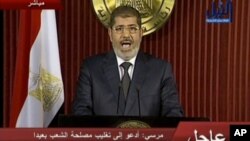
Speaking on national television Thursday amid anti-government protests gripping Cairo, Morsi insisted that dialogue is the only solution to the country's constitutional crisis. It is unclear whether opposition leaders will attend the president's proposed "comprehensive" dialogue on Saturday.
Morsi said he will not tolerate killings or sabotage. He said seven people were killed outside the presidential palace, with more than 700 others injured during demonstrations this week. The president says 80 people have been arrested for crimes, including the use of firearms, and he described some of the detainees as "hired for money."
U.S. President Barack Obama spoke with Morsi by telephone Thursday to voice "deep concern" about the protest deaths and injuries.
A White House statement said Obama also urged all Egyptian political leaders to make clear to their supporters that violence is unacceptable.
The U.S. president welcomed the Morsi announcement of a dialogue with the opposition, urging opposition leaders to join the talks without preconditions.
Morsi said he will form a new advisory panel to write a new draft constitution if voters on December 15 reject the one passed by his Islamist followers last week. Critics say that document was drafted solely by Islamists without opposition input.
The leader of the umbrella opposition coalition, Mohammed ElBaradei, told supporters Wednesday that he and his colleagues would not negotiate with the president until he withdraws the draft constitution and cancels the December 15 referendum.

Soldiers have erected barricades with concrete blocks and barbed wire around the presidential palace in Cairo, the site of deadly clashes during earlier protests this week.
Speaking on national television Thursday amid anti-government protests gripping Cairo, Morsi insisted that dialogue is the only solution to the country's constitutional crisis. It is unclear whether opposition leaders will attend the president's proposed "comprehensive" dialogue on Saturday.
Morsi said he will not tolerate killings or sabotage. He said seven people were killed outside the presidential palace, with more than 700 others injured during demonstrations this week. The president says 80 people have been arrested for crimes, including the use of firearms, and he described some of the detainees as "hired for money."
U.S. President Barack Obama spoke with Morsi by telephone Thursday to voice "deep concern" about the protest deaths and injuries.
A White House statement said Obama also urged all Egyptian political leaders to make clear to their supporters that violence is unacceptable.
The U.S. president welcomed the Morsi announcement of a dialogue with the opposition, urging opposition leaders to join the talks without preconditions.
Morsi said he will form a new advisory panel to write a new draft constitution if voters on December 15 reject the one passed by his Islamist followers last week. Critics say that document was drafted solely by Islamists without opposition input.
The leader of the umbrella opposition coalition, Mohammed ElBaradei, told supporters Wednesday that he and his colleagues would not negotiate with the president until he withdraws the draft constitution and cancels the December 15 referendum.