MAZOURA, Egypt - Egypt's economic stagnation was a key factor in the revolt against the old government. In one village, voters worried about their future are divided over which of the two presidential candidates could help them move forward.
Life in rural Egypt under the previous government was hard. Poverty was endemic - a third of Egyptians live on less than $2 a day. Prospects for change were almost nil. So the promise of new leadership has many in the countryside upbeat.
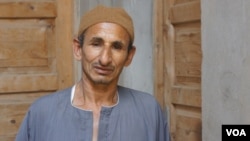
In Mazoura, a village in Beni Suef, south of Cairo, farmer Abu Samra Zaki Mahmoud is pinning his hopes on presidential candidate Ahmed Shafiq - an old guard technocrat credited with bringing Egypt's aviation up to modern standards.
Farmer Abu Samra Zaki Mahmoud tries to drum up support for Egyptian presidential candidate Ahmed Shafiq, Mazoura, Egypt, June 7, 2012. (E. Arrott/VOA)
Samra says Shafiq is a man of experience in politics and economics. “He knows how to put the country in shape," he said.
Samra is canvassing Mazoura on Shafiq's behalf. With some voters, it's an easy sell.
A voter calls Shafiq a role model - someone who would benefit villagers like himself and bring reform.
Like many Egyptians, the people of Mazoura feel the burden of rising prices and unemployment, declining subsidies and a bureaucracy that quashes initiative.
But those same conditions helped propel Shafiq's rival, the Muslim Brotherhood's Mohamed Morsi, to first place in an earlier round of voting.
The Islamist group's long history of grassroots charity has given it an edge, as evidenced as Abu Samra makes his way through a particularly pro-Morsi lane.
Despite the differences that spawn such loyalties, some say Morsi and Shafiq are surprisingly close on economic matters.
"Both candidates subscribe to a private-led economy, to some government intervention in the form of rules and regulations to streamline the process," said Magda Kandil, the director of the Egyptian Center for Economic Studies. "There are more of targeted social measures to provide a pro-active support to the small and medium enterprises.”
The similarities won't stop some voters from arguing over the candidates' relative merits.
Kandil says voters should be concerned that neither candidate has shown specifically how he plans to achieve ambitious goals.
"They are not very concrete in terms of the instruments and accordingly I am very concerned about their ability to connect with reality,” said Kandil.
It’s an observation that, if born out, likely means neither candidate will be able to ease economic woes any time soon.